
|
Getting your Trinity Audio player ready...
|
Understanding grading scales is important for academic success. Many students feel confused when they see different grading systems at school. Some schools use letters like A, B, and C. Others use numbers or percentages. This confusion can make it hard to know where you stand in class.
Teachers also face challenges with grading scales. They need to pick a system that’s fair and easy to understand. The right grading scale helps everyone stay on the same page. It shows students exactly what they need to do to improve. Many educators speed up grading by using digital grade calculators instead of manual methods.
This guide covers everything about grading scales. Students will learn how to read their grades. Teachers will find tips for choosing the best system. By the end, everyone will understand how grading works and how to use it to succeed.
What is a Grading Scale?

A grading scale is a system that measures how well students perform in school. Think of it like a ruler that measures learning instead of length. Schools use these scales to calculate assignments into grades that everyone can understand.
Schools use grading scales for several important reasons. First, they make grading fair and consistent. When every teacher uses the same scale, students know what to expect. Second, grades help students see their strengths and weaknesses. A low grade in math tells a student they need more practice. Third, grading scales help parents understand how their children are doing in school.
Grading scales help measure student performance in clear ways. Instead of saying “you did okay,” a grade gives specific information. An A means excellent work. A C means average performance. These measurements help students set goals and track their progress over time.
Understanding the Letter Grade Scale
How the Grade Scale Works
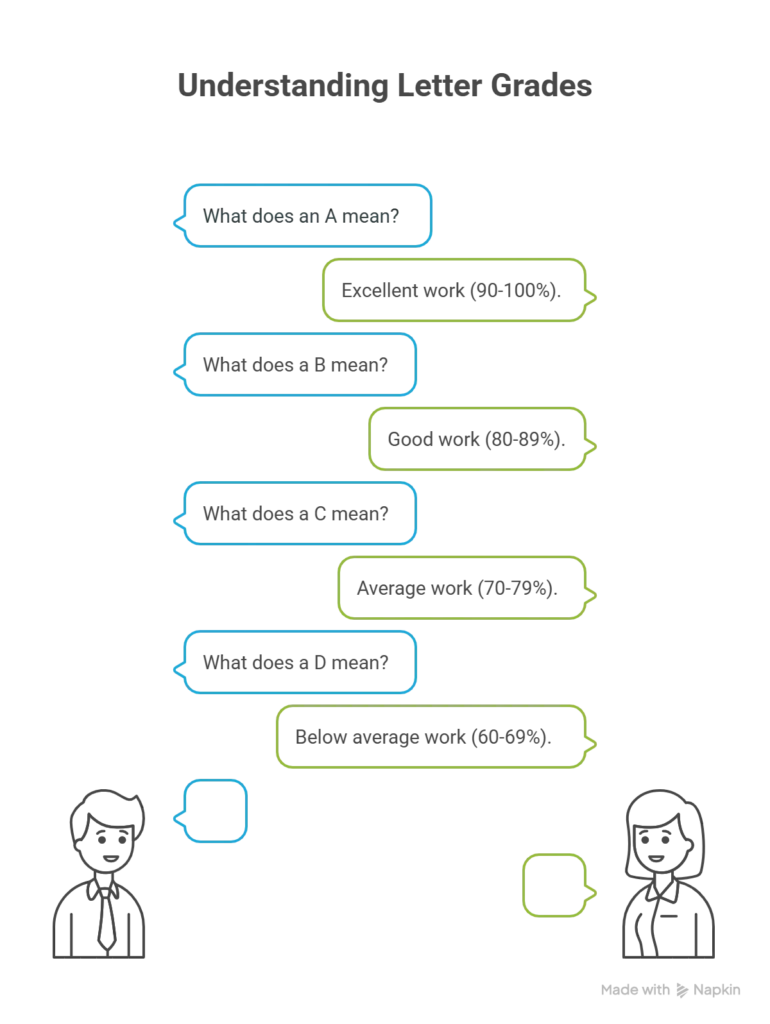
The letter grade scale is the most common grading system in American schools. It uses letters from A to F to show how well a student performed. Each letter represents a different level of achievement.
Here’s what each letter grade means:
- A = Excellent work (90-100%)
- B = Good work (80-89%)
- C = Average work (70-79%)
- D = Below average work (60-69%)
- F = Failing (below 60%)
These are the standard grade scale ranges used in most schools. An A shows that a student understood almost everything. A B means they got most of it right. A C shows basic understanding. A D means they struggled with the material. An F means they didn’t meet the minimum requirements.
Common Letter Grade Scale Formats
Most schools in the USA use the traditional letter grade scale described above. However, some schools make small changes to fit their needs. These variations help schools match their educational philosophy.
Different institutions use slightly different ranges. Some schools say an A starts at 93% instead of 90%. Others might have an A start at 92%. College grading is often stricter than high school grading. What earns an A in high school might only get a B in college.
International grading systems can look very different. Many European countries use numbers from 1 to 10 or 1 to 20. Some Asian countries use 100-point scales. Canadian schools often use percentages instead of letters. Students moving between countries need to learn new grading systems.
Breaking Down Grading Scale Percentages
Standard Percent Grading Scale
The percent grading scale shows grades as numbers from 0 to 100. This system is easy to understand because most people know what percentages mean. A 95% means you got 95 out of 100 points possible.
Here are typical percentage ranges for each letter grade:
- A = 90% to 100%
- B = 80% to 89%
- C = 70% to 79%
- D = 60% to 69%
- F = below 60%
These grading scale percentages help students know exactly where they stand. If someone scores 85% on a test, they can see that’s a B. The percentage tells them they got most questions right.
Grading Scale by Percentage Chart
A grading scale by percentage chart provides a visual way to understand grades. These charts show the relationship between percentage scores and letter grades. Students can look at a chart and instantly know their grade.
Here’s a simple reference guide:
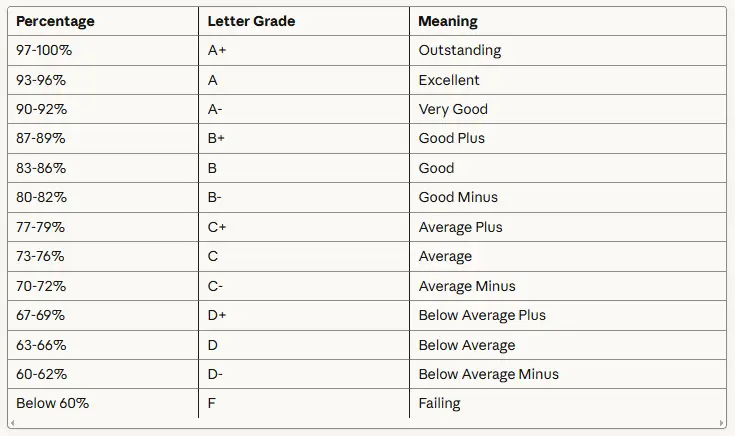
This chart makes it easy to understand grading scale percentage conversions. Students can keep this reference handy when checking their grades.
Using a Grading Scale Calculator
How Grading Scale Calculators Help
A grading scale calculator is an online tool that does the math for you. Students enter their scores, and the calculator figures out their grade. This saves time and reduces mistakes.
These calculators offer several benefits. They’re fast and accurate. Students don’t need to do complex math in their heads. Calculators can handle weighted grades where different assignments count for different amounts. They also show what scores students need on future tests to reach their goal grades.
Students should use calculator tools when planning their study time. Before a final exam, a calculator can show what score is needed to get an A in the class. This helps students set realistic goals and focus their studying.
Popular Grading Scale Calculator Tools
Many free grading scale calculator options are available online. These tools work on computers and phones. Most are simple to use and don’t require any downloads.

When looking for a good calculator, check for these features:
- Easy input for test scores and assignment grades
- Support for weighted grades
- “What-if” calculations for future assignments
- Clear display of current grade
- Options for different grading scales
- Mobile-friendly design
The best calculators let students save their information. This way, they can update grades throughout the semester without starting over each time.
Common Grading Scale Charts and Tables
Reading a Grading Scale Chart
A grading scale chart displays grade information in an organized table. These charts help students quickly find what grade matches their score. Reading these charts is an important skill.
Charts typically show several pieces of information. The first column usually lists percentage ranges. The next column shows the matching letter grade. Some charts include GPA values or grade point equivalents. Others might show what each grade means in words.
To use a chart, students find their percentage score in the first column. Then they look across the row to see their letter grade. For example, if someone scored 88%, they would find the 80-89% row and see that equals a B.
Creating Your Own Reference Chart
Students can make a personalized grading scale chart for their own use. This helps track grades in all classes throughout the year. A custom chart can include extra information that matters to individual students.

Here are steps to make a grade tracker:
- Get a notebook or create a digital document
- Make columns for each class
- Add rows for assignments, tests, and projects
- Include a column for grade percentages
- Calculate running totals as new grades come in
- Update the chart weekly
Organizing grades by subject helps students see patterns. They might notice they always do well in English but struggle in math. By semester, students can see how their grades change over time. This information helps them adjust their study habits.
Special Grading Scales for Different Tests
Grading Scale for 20 Question Test
A grading scale for 20 question test works differently than tests with 100 questions. With fewer questions, each one counts for more points. Missing just one or two questions can change a grade significantly.
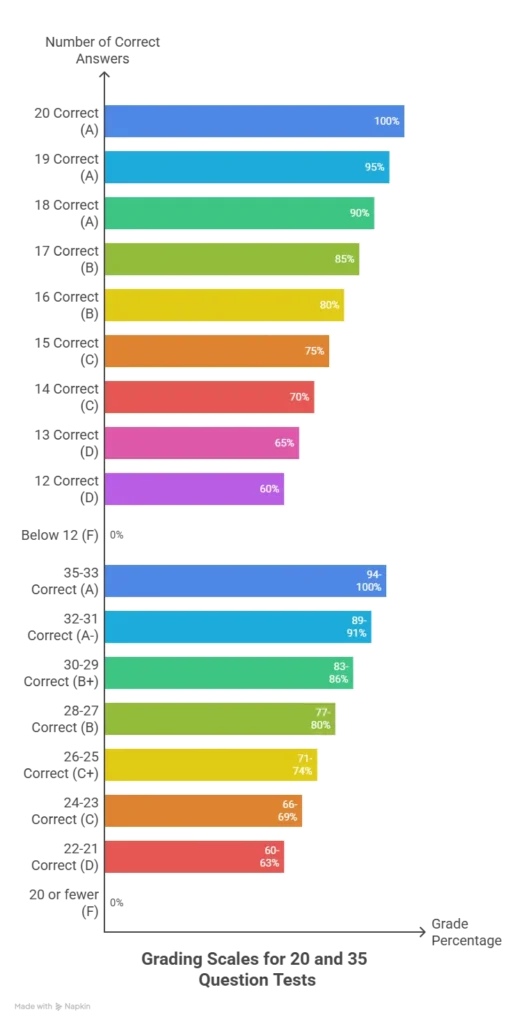
On a 20-question test, each question is usually worth 5 points. Here’s how the scoring breaks down:
- 20 correct = 100% (A)
- 19 correct = 95% (A)
- 18 correct = 90% (A)
- 17 correct = 85% (B)
- 16 correct = 80% (B)
- 15 correct = 75% (C)
- 14 correct = 70% (C)
- 13 correct = 65% (D)
- 12 correct = 60% (D)
- Below 12 = Failing (F)
Students need to be extra careful on shorter tests. Every question matters more. Missing 3 questions on a 20-question test drops the grade to a C. On a 100-question test, missing three might still be an A.
Grading Scale for 35 Questions
A grading scale for 35 questions falls in the middle range for test length. Each question is worth about 2.86 points, though teachers often round to make math easier.
Here’s a common grading approach for 35-question tests:
- 35-33 correct = A (94-100%)
- 32-31 correct = A- (89-91%)
- 30-29 correct = B+ (83-86%)
- 28-27 correct = B (77-80%)
- 26-25 correct = C+ (71-74%)
- 24-23 correct = C (66-69%)
- 22-21 correct = D (60-63%)
- 20 or fewer = F (below 60%)
Mid-length tests like these are common in many subjects. They’re long enough to cover several topics but short enough to finish in one class period.
Understanding Point-Based Grading Systems
The 4 Point Grading Scale
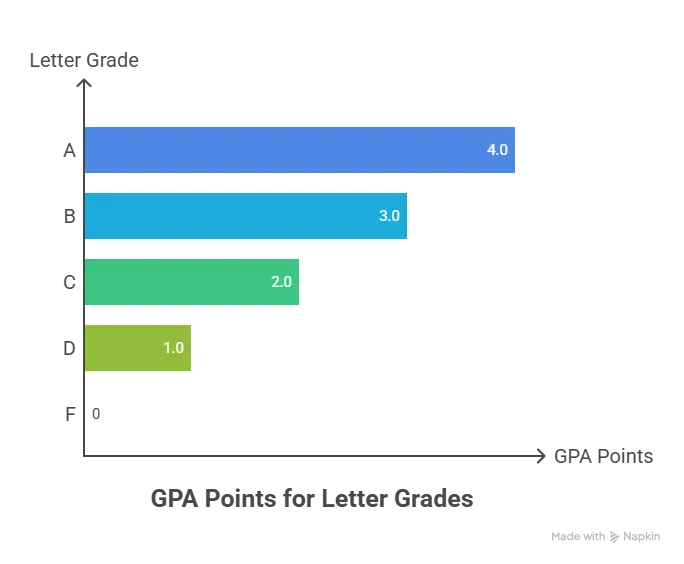
The 4 point grading scale is another name for the GPA (Grade Point Average) system. This system converts letter grades into numbers from 0 to 4. Colleges and universities use this system a lot.
Here’s how the 4.0 GPA system works:
- A = 4.0 points
- B = 3.0 points
- C = 2.0 points
- D = 1.0 point
- F = 0 points
Some schools add plus and minus grades:
- A+ = 4.0
- A = 4.0
- A- = 3.7
- B+ = 3.3
- B = 3.0
- B- = 2.7
- C+ = 2.3
- C = 2.0
- C- = 1.7
- D+ = 1.3
- D = 1.0
- F = 0
Converting letter grades to point values helps calculate overall GPA. Students add up all their grade points and divide by the number of classes. A student with two As (4.0 each) and two Bs (3.0 each) would have: (4.0 + 4.0 + 3.0 + 3.0) ÷ 4 = 3.5 GPA.
1000 Point Grading Scale Calculator
A 1000 point grading scale calculator helps students track grades in classes that use large point totals. Some teachers assign points throughout the semester and add them all up.
Large point systems work like this: Every assignment, quiz, test, and project has a point value. A homework assignment might be worth 10 points. A quiz could be 50 points. A major test might be 200 points. At the end of the semester, all points are added together.
Schools use high point totals when they have many assignments throughout the year. If a class has 20 assignments at 10 points each, 10 quizzes at 20 points each, and 5 tests at 100 points each, the total is 900 points. Adding a final exam worth 100 points brings the total to 1000.
Students track their earned points and divide by total possible points. Someone who earned 850 out of 1000 points would have 85%, which is a B.
Point System Grading Calculator Benefits
A point system grading calculator offers advantages for both students and teachers. These calculators help manage grading systems where different assignments have different point values.
The main advantage is flexibility. Teachers can assign points based on how important each assignment is. A major research paper might be worth 300 points while a small quiz is only 25 points. This automatically weights grades without complex percentages.
To track points better, students should:
- Keep a running total of points earned
- Know the total possible points for the semester
- Calculate their current percentage regularly
- Identify which upcoming assignments are worth the most points
- Focus extra study time on high-point assignments
Point systems make it clear what matters most. Students can see that a 200-point test affects their grade more than a 10-point assignment.
Advanced Grading Scale Formats
Grading Scale with Plus and Minus
A grading scale with plus and minus adds more detail to standard letter grades. Instead of A, B, C, D, and F, schools use A+, A, A-, B+, B, B-, and so on. This system gives teachers more options when grading.
Plus and minus grades show finer differences in student performance. An A- (90-92%) shows good work but not quite as strong as a regular A (93-96%). A B+ (87-89%) is better than a B (83-86%) but not quite an A.
These detailed grades affect GPA calculations. An A is worth 4.0, but an A- might be 3.7. A B+ could be 3.3, while a regular B is 3.0. Over several classes, these small differences add up. A student with A- grades will have a lower GPA than one with straight As.
Weighted vs Unweighted Grading Scales
Understanding the difference between weighted and unweighted grading scales helps students calculate grades. These two systems affect final grades in different ways.
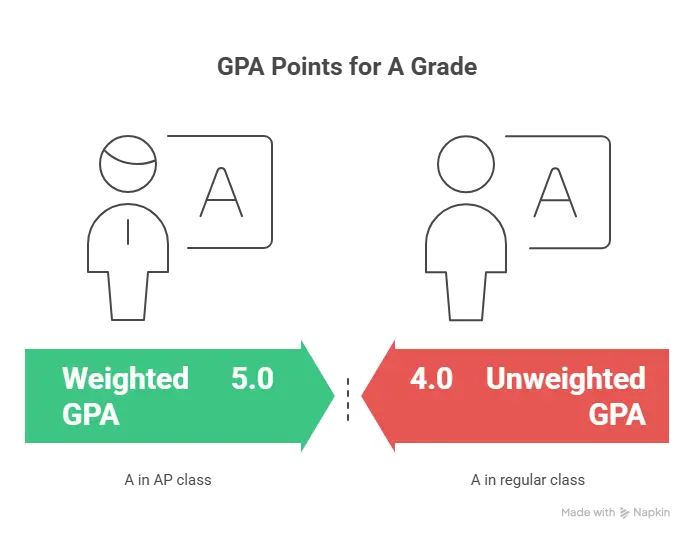
Unweighted grading treats all classes the same. Every A is worth 4.0 points. It doesn’t matter if the class was easy or hard. Regular math and honors math both give the same GPA points for an A.
Weighted grading gives extra points for harder classes. Honors classes might add 0.5 points. AP or IB classes might add 1.0 point. An A in an AP class could be worth 5.0 instead of 4.0. This system rewards students who take challenging courses.
The impact on final grades can be significant. Two students might both have straight As. But if one took all regular classes and the other took AP classes, the AP student would have a higher GPA under a weighted system.
How to Calculate Your Grade Using Different Scales
Converting Grading Scale Percent to Letters
Learning to convert grading scale percent to letter grades is an important skill. This conversion helps students quickly understand their performance level. The process is straightforward once you know the ranges.
Here’s the step-by-step conversion process:
- Look at your percentage score
- Find which range it falls into
- Match that range to the letter grade
- Check if your school uses plus/minus grades
- Find the exact grade designation
For example, if a student scored 87% on a test:
- Step 1: The score is 87%
- Step 2: This falls in the 80-89% range
- Step 3: That range equals a B
- Step 4: With plus/minus, 87-89% is a B+
- Step 5: The final grade is B+
Quick calculation tips help speed up this process. Remember that 90s are As, 80s are Bs, 70s are Cs, and 60s are Ds. Anything below 60 is failing. Once you memorize these basic ranges, converting becomes automatic.
Understanding Grading Scale Percentage Weights
Assignment weights change how grading scale percentage scores affect final grades. Not all assignments count the same amount. Understanding weights helps students calculate accurate grade predictions.
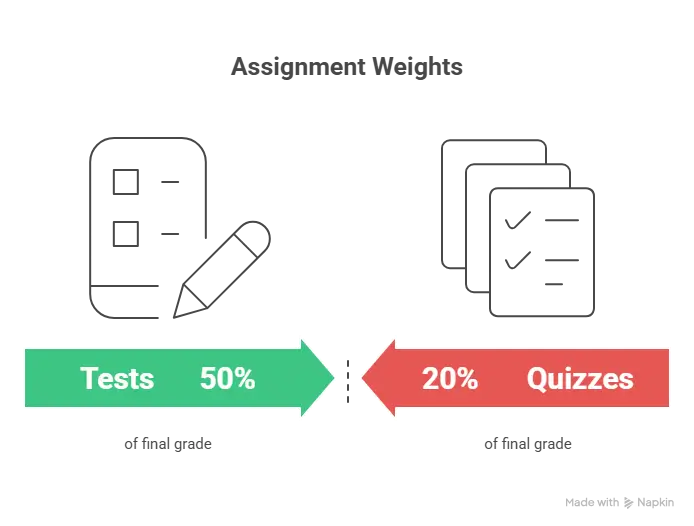
Here’s how assignment weights work. Teachers decide what percentage of the final grade each category is worth. A typical breakdown might be:
- Tests = 50% of final grade
- Quizzes = 20% of final grade
- Homework = 15% of final grade
- Projects = 10% of final grade
- Participation = 5% of final grade
To calculate weighted averages, follow these steps:
- Find the average score in each category
- Multiply each average by its weight (as a decimal)
- Add all the weighted scores together
- The result is the final grade percentage
Example calculation:
- Tests average: 85% × 0.50 = 42.5
- Quizzes average: 90% × 0.20 = 18.0
- Homework average: 95% × 0.15 = 14.25
- Projects average: 88% × 0.10 = 8.8
- Participation: 100% × 0.05 = 5.0
- Total: 42.5 + 18.0 + 14.25 + 8.8 + 5.0 = 88.55% (B+)
This student has excellent homework and participation but lower test scores. The weighted system shows that test performance matters most.
Tips for Students: Making Grading Scales Work for You
Students can use grading scales to improve their academic performance. Understanding how grades work is the first step toward better results. These practical tips help students take control of their learning.
Track your grades by checking them weekly. Don’t wait until report cards come out. Use a notebook or app to record every assignment, quiz, and test score. Calculate your current grade regularly. This helps catch problems early when there’s still time to fix them.
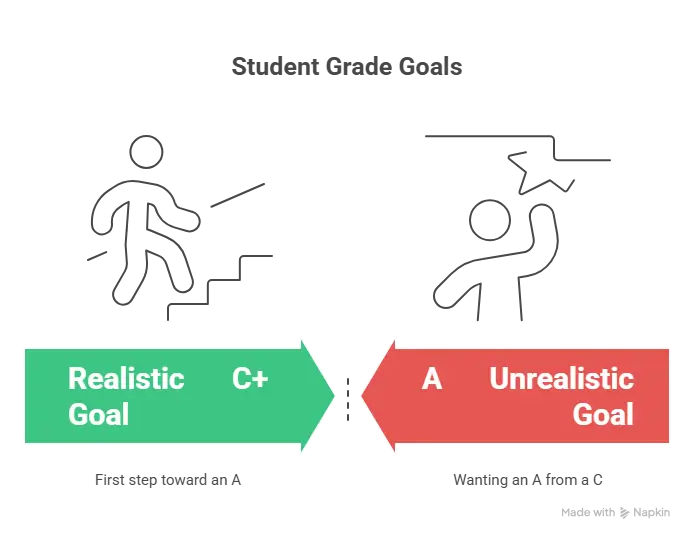
Set realistic grade goals based on current performance. If someone has a C and wants an A, they need a clear plan. Break the goal into smaller steps. First aim for a C+, then a B-, and work up from there. Setting achievable mini-goals keeps students motivated.
Use grading scales to improve performance by identifying weak areas. If test scores are low but homework grades are high, focus more on test preparation. If one subject drags down the GPA, spend extra study time there. The grading scale shows exactly where improvement is needed.
Tips for Teachers: Choosing the Right Grading Scale
Teachers face important decisions when selecting a grading system. The right scale makes grading fair and helps students learn. These tips guide teachers toward effective grading choices.
Factors to Consider When Selecting a Scale
It include student age, subject matter, and school policies. Younger students might need simpler systems. Complex subjects might need more detailed grading. Always check what your school or district requires.
Think about what behavior you want to encourage. If effort matters, include it in the grading scale. If mastery is the goal, focus grades on test performance. The grading system should match teaching philosophy.
Communicating grading systems to students is crucial for success. Explain the scale on the first day of class. Provide written explanations students can take home. Show examples of how grades are calculated. Answer questions patiently.
Give students a sample calculation early in the semester. Walk through how different scores on assignments would affect the final grade. This helps students understand what they need to do to succeed.
Common Mistakes to Avoid
It include changing the grading system mid-semester. Students need consistency. Don’t make the scale too complicated. If students can’t understand how grades are calculated, the system isn’t working.
Avoid grading systems that discourage effort. If one bad test ruins an entire semester grade, students might give up. Build in opportunities for improvement and recovery.
Comparing Different Grading Scale Systems
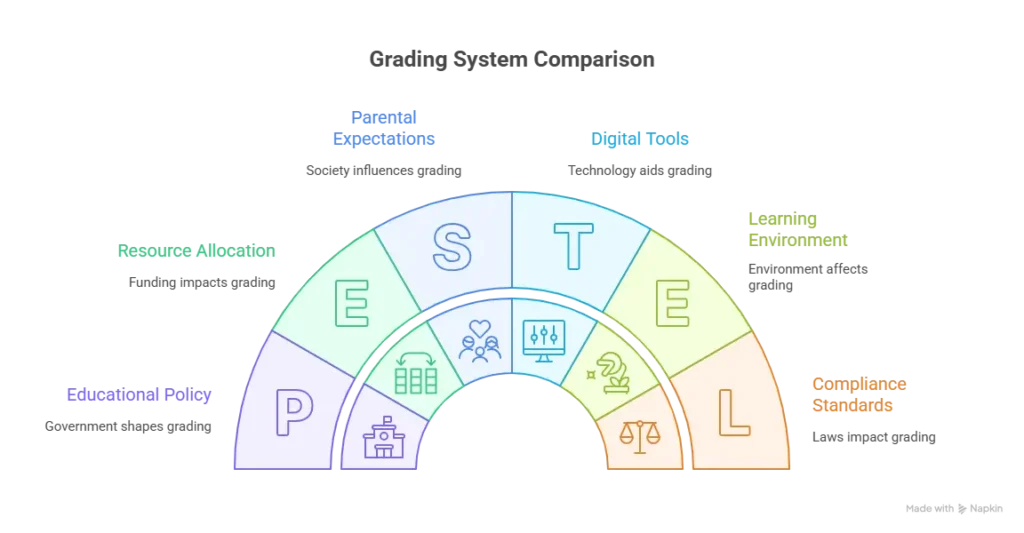
Schools use various grading approaches. Each system has strengths and weaknesses. Understanding these differences helps everyone make informed choices about education.
Traditional vs Modern Approaches
It show how grading has evolved. Traditional systems focused only on test scores. Modern approaches often include homework, projects, participation, and other factors. Some newer systems focus on skills mastery rather than points.
Traditional letter grades (A, B, C, D, F) remain most common. They’re simple and widely understood. Modern alternatives include standards-based grading, where students are rated on specific skills. Some schools use pass/fail systems or narrative evaluations instead of grades.
Pros and cons of various systems:
Letter Grade System:
Pros: Simple, familiar, easy to compare
Cons: May not show specific strengths and weaknesses
Percentage System:
Pros: Precise, shows exact performance level
Cons: Can feel harsh when 89% and 90% are different letter grades
Point System:
Pros: Flexible, shows relative weight of assignments
Cons: Can be confusing with large point totals
Standards-Based:
Pros: Shows specific skill mastery, focuses on learning
Cons: Less familiar, harder to convert to GPA
Which scale might work best for you depends on goals and context. Students heading to college need traditional grades for transcripts. Younger students might benefit from standards-based systems that focus on learning. Families should discuss with teachers what each grading system means.
Conclusion
Understanding grading scales empowers both students and teachers. These systems provide clear feedback about academic performance. Students who know how grades work can set better goals and track progress.
This guide covered the essential grading scale concepts. We explored letter grades, percentages, and point systems. We looked at calculators and charts that make grade tracking easier. We discussed special scales for different test and advanced formats like weighted grading.
Use this knowledge to succeed in school. Students should check grades and understand what each number means. Teachers should choose grading systems that match their educational goals clearly.
Remember that grades measure learning, not worth as a person. A grade shows current performance and areas for growth. With the right tools and understanding, everyone can improve their academic results.
FAQs
What is the most common letter grade scale?
The most common letter grade scale in American schools uses A, B, C, D, and F. An A represents 90-100%, B is 80-89%, C is 70-79%, D is 60-69%, and F is below 60%. Many schools also add plus and minus designations. This system has been standard in the United States for decades. Colleges and high schools almost all use this same basic scale.
How do you convert percentages to letter grades?
To convert percentages to letter grades, match your percentage score to the standard ranges. Scores from 90-100% are As. Scores from 80-89% are Bs. Scores from 70-79% are Cs. Scores from 60-69% are Ds. Anything below 60% is failing. If your school uses plus/minus grades, you’ll need to know the more detailed ranges. For example, 87-89% might be a B+ while 83-86% is a regular B.
What does a 4 point grading scale mean?
The 4 point grading scale is the GPA system used by most colleges and high schools. Each letter grade converts to a number. An A equals 4.0 points, B equals 3.0, C equals 2.0, D equals 1.0, and F equals 0. To calculate GPA, you add up all your grade points and divide by the number of classes. A student with two As and two Bs would have (4.0 + 4.0 + 3.0 + 3.0) ÷ 4 = 3.5 GPA.
How do grading scales differ between schools?
Grading scales vary in several ways between schools. Some schools start the A range at 90%, others at 93%. College grading is usually stricter than high school grading. Private schools might use different scales than public schools. International schools use completely different systems. Some schools include plus/minus grades while others don’t. Some weight honors and AP classes more than regular classes. Always check your specific school’s grading policy in the student handbook.
Can I calculate my grade without a calculator?
Yes, you can calculate grades without a calculator for simple situations. For a single test, divide your score by the total possible points and multiply by 100. For example, 17 correct out of 20 questions: 17 ÷ 20 = 0.85, then 0.85 × 100 = 85%. For course grades with weighted categories, the math gets harder. You need to multiply each category average by its weight, then add everything. Using a point system grading calculator makes this much easier and prevents mistakes.







Well-written piece!
I truly enjoyed the manner you esplained this topic.
It’s so good to seee practical insights like this onn
the web.
Thanks for taking the time to write.
Keep up the good work!
Thanks for your kind words!