
How to Use a Weighted Grade Calculator
Last updated: May 2026
A weighted grade calculator computes your course grade by multiplying each assignment category's score by its assigned percentage weight, then summing the results. Unlike a simple average, it treats a final exam worth 35% differently from a homework category worth 5% because they are different, and your grade should reflect that.
You got a 68% on your midterm. You added up all your scores, divided by the number of assignments, and got a number that didn't match your professor's gradebook. That wasn't a math mistake. It was the wrong formula entirely.
Most courses don't run on simple averages. They run on weighted averages. And if you've never been shown how those two calculations differ, which most students haven't, because almost no one teaches this explicitly, then every grade estimate you've run this semester has been off.
This guide covers the weighted average formula with a real worked example, how to handle mid-semester calculations when you haven't completed every category yet, and the difference between high school GPA weighting and college course weighting. It also gives you the exact formula for finding what score you need on your final to pass.
This works best for courses that list assignment categories with percentage weights on the syllabus. If your professor uses a raw point total, every assignment has a fixed number of points, and there is no category breakdown, the weighted formula doesn't apply to your situation.
Why Your Simple Average Is Giving You the Wrong Grade
Here's the thing: adding all your scores and dividing by the number of assignments only works when every assignment carries equal weight. That's rarely how real courses are structured.
A course with homework weighted at 20%, quizzes at 15%, a midterm at 30%, and a final exam at 35% is making something precise: your final exam moves your course grade nearly twice as much as your quiz average. A simple average ignores that entirely. It treats a 20-minute homework set and a three-week cumulative exam as identical inputs, which produces a result that can be off by 5 to 10 percentage points in either direction.
Students who've run the simple average often report their result looks either better or worse than what the professor's portal shows, then they spend time trying to figure out which assignments they "forgot." They didn't forget anything. The formula was wrong from the start.
Read More → How to study for a final exam when you're running short on time
Weighted grade calculation answers a specific question. Not "what's my average score?" but "what percentage of this course's total credit have I actually earned?"
How a weighted grade differs from a simple average is a distinction most grade guides skip entirely. A simple average divides your score total by the number of items. A weighted average multiplies each category score by its share of the final grade before summing. According to ACHA 2024 data compiled by EssayPro in 2025, 61% of teens report stress specifically about producing satisfactory grades. This statistic suggests most students are tracking grades constantly, often with the wrong method, producing the wrong number.
Why a 68% midterm doesn't mean your course grade is 68% is the question most students ask after a rough test. If your midterm is worth 30% of the final grade, it contributes only 0.30 × 68 = 20.4 points toward your total out of a possible 30. That's its actual impact on your course standing. The remaining 70% of your grade hasn't been decided yet.
The Weighted Grade Formula - Step by Step
The math involves three operations: multiply, multiply, then add. That's it.
To calculate your weighted grade, follow these steps:
- Write each category's percentage weight as a decimal (20% = 0.20).
- Write your current score in each category as a decimal (88% = 0.88).
- Multiply each score decimal by its weight decimal (0.88 × 0.20 = 0.176).
- Repeat for every completed category.
- Add all results together and multiply by 100. That number is your grade percentage.
(Each step is one action. No step requires more than basic multiplication.)
Worked Example Using a Real Syllabus
Syllabus structure: homework 20%, quizzes 15%, midterm 30%, final exam 35%.
Current scores: homework average 88%, quiz average 74%, midterm 68%. Final exam not yet taken.
| Category | Your Score | Weight | Weighted Score |
|---|---|---|---|
| Homework | 88% | × 0.20 | = 17.6 |
| Quizzes | 74% | × 0.15 | = 11.1 |
| Midterm | 68% | × 0.30 | = 20.4 |
| Total so far | = 49.1 |
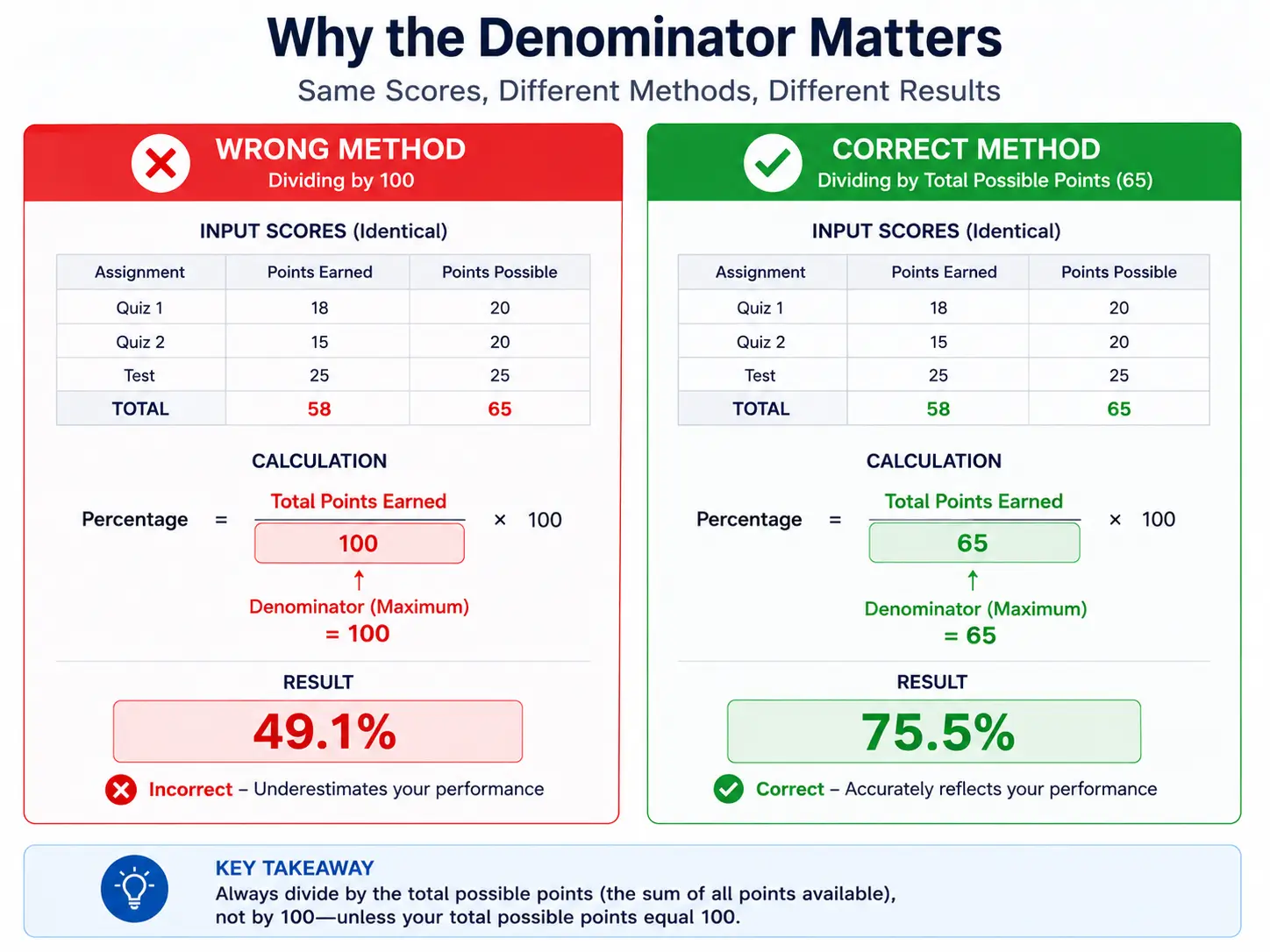
Now divide: 49.1 ÷ 65 = 75.5%
The 65 in that division is not arbitrary; it's the sum of only the completed weights (20 + 15 + 30). That denominator is where most students, and most online calculators, make a critical error.
Read More → Convert your final course grade to GPA points
Using a weighted average grade calculator mid-semester requires adjusting the denominator based on what you've actually completed. According to the standard weighted-average methodology, dividing by 100 when only 65% of your grade categories are done deflates your result by several percentage points. The correct approach divides only by the sum of completed weights, a distinction that Calculator.net, RapidTables, and CalculatorSoup all currently omit from their calculator interfaces.
How to Handle Mid-Semester Calculations
This is the section that doesn't exist anywhere else on this topic.
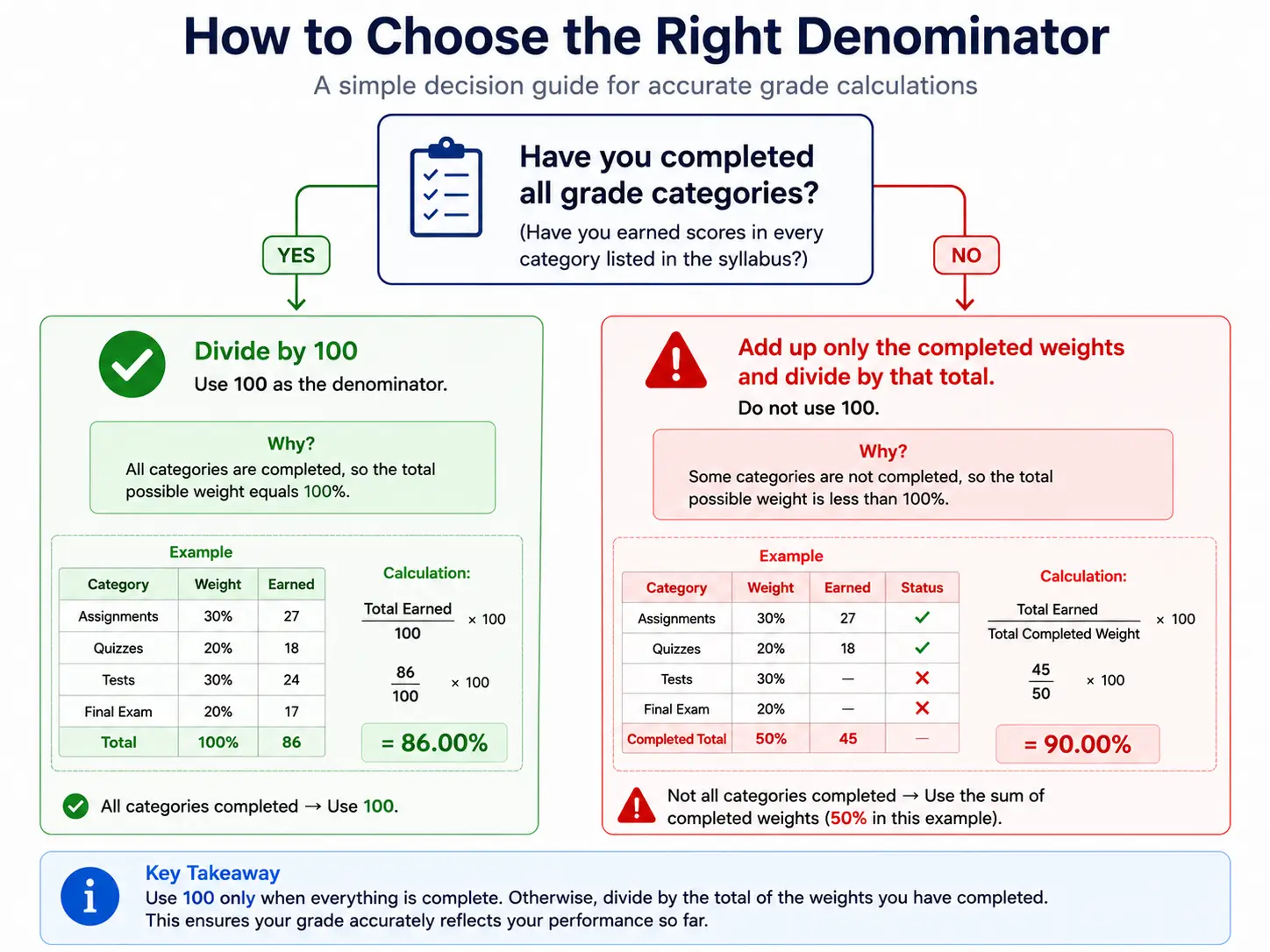
If you haven't completed every grade category, you cannot divide your weighted score by 100. That number assumes every category is complete. Instead, divide by the sum of only the weights that have actual scores attached.
Partial-semester formula:
Current Grade = (Sum of weighted scores earned) ÷ (Sum of weights completed) × 100
Or maybe I should say: imagine your course only has the categories you've taken so far. The final exam doesn't exist yet. The denominator shrinks to match. You're not penalized for a final you haven't taken; you're measuring only what's happened.
Look, if you're mid-semester and your weighted grade calculator is showing something significantly lower than your professor's portal, here's what's almost certainly happening: the tool is dividing by 100 instead of 65. One number, several points of difference. That's not a rounding quirk. It's the formula being applied to the wrong scope.
According to a 2025 survey compiled by EssayPro, citing ACHA 2024 data, 75% of high school students feel academic stress consistently. Running a miscalculated grade and genuinely believing it is a surprisingly common source of that stress, and it takes one denominator correction to fix.
High School GPA Weighting vs. College Course Weighting
This confusion appears constantly in search results, and no competing guide resolves it directly.
High school GPA weighting vs. college course category weighting: High school GPA weighting adds bonus grade points to your cumulative GPA for completing AP, IB, or honors courses. An A in AP Chemistry becomes a 5.0 instead of 4.0 on a weighted scale. College course category weighting distributes your final grade across assignment types within one course. The key difference: one affects your transcript GPA; the other affects your grade in a single class only.
Which System Are You Actually Dealing With?
Quick Comparison
| Type | Best For | Key Benefit | Limitation |
|---|---|---|---|
| High school GPA weighting | Students in AP/IB/honors tracks | Rewards rigor on college transcript | Does not change individual assignment grades |
| College course category weighting | Any student with a weighted syllabus | Reflects assignment priority accurately | Requires knowing each category's weight |
| Raw point-based grading | Courses without percentage categories | Straightforward: points earned ÷ points possible | No weighted formula needed or applicable |
| Hybrid (points within weighted categories) | Courses that combine both systems | Granular credit per assignment, categories still weighted | Requires a two-step calculation |
Some educators argue that point-based grading is more transparent because every assignment has a concrete, comparable value from day one. That's genuinely valid for courses where all assignments test roughly the same depth of knowledge.
But when a course deliberately separates daily practice from demonstrated mastery, using homework to build skills and exams to test them, category weighting reflects that hierarchy accurately. Treating a Tuesday warm-up quiz and a cumulative final as equal inputs distorts the grade just as badly as the simple average error does.
Read More → How to calculate your cumulative GPA with AP and honors courses
What Score Do You Actually Need on Your Final?
Here's what most students actually want to know once the midterm panic sets in.
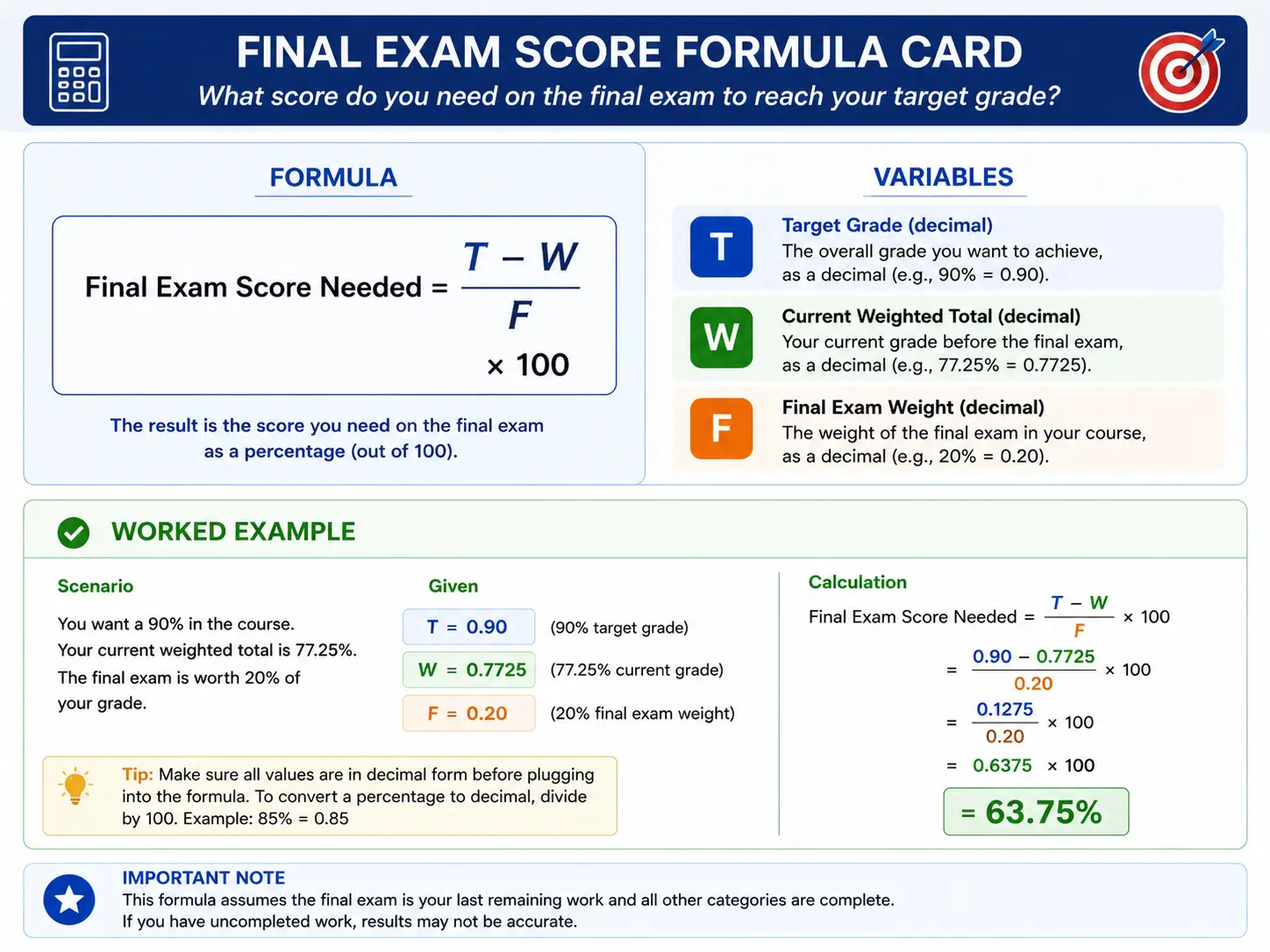
Required Final Score = (Target Grade − Current Weighted Total) ÷ Final Exam Weight
Using the example: target course grade 73%, current weighted total 49.1, final exam weight 0.35.
Required Final = (73 − 49.1) ÷ 0.35 = 23.9 ÷ 0.35 = 68.3%
You need a 68.3% on the final to finish the course at 73%.
That's a lot more manageable than the raw midterm score made it feel.
I've seen conflicting approaches on which target grade to plug in; some sources say the minimum letter-grade threshold (typically 73% for a C), others say the institutional passing floor from your academic handbook.
My read: use whatever your specific program defines as the passing minimum for that course, because it varies. Some majors require a 75% to advance. Some departments pass at 60%. Assuming 70% is fine until it isn't and checking your handbook takes 90 seconds.
Learn More → EssayPro 2025 Academic Stress Survey citing ACHA 2024