
How to Use a High School GPA Calculator (Weighted & Unweighted)
Last updated: May 2026
A high school GPA calculator computes your Grade Point Average either on the standard unweighted 4.0 scale or on a weighted scale that adds bonus points for AP, Honors, and IB courses. The two calculations produce different numbers, and colleges may use either one, or recalculate your GPA entirely.
You have a 4.3 weighted GPA. A college lists "3.9 GPA minimum." And now you're not sure if you qualify.
Here's what nobody tells you upfront: colleges don't all use the same GPA. Some review your weighted number. Some prefer unweighted. And the most selective schools ignore your transcript's GPA entirely, recalculating it themselves using only your 10th and 11th grade academic courses, with PE, electives, and freshman year stripped out completely.
That recalculated figure can be meaningfully different from the number your school portal shows.
This guide covers both the unweighted and weighted GPA formulas with a real side-by-side example, explains why the bonus point scale your calculator defaults to may not match your school's actual system, and answers the question most students ask last but should ask first: which GPA do colleges actually evaluate?
This guide works best for U.S. high school students on semester or trimester grading schedules. It doesn't address IB diploma programmes reporting on the 7-point scale, homeschool transcript GPA, or dual-enrollment college credits.
Unweighted GPA: The 4.0 Scale Every Student Knows
An unweighted GPA treats every course equally. An A in AP Calculus and an A in gym class both contribute 4.0 to your average. Course difficulty is invisible to the formula.
The standard conversion: A = 4.0, A− = 3.7, B+ = 3.3, B = 3.0, B− = 2.7, C+ = 2.3, C = 2.0, C− = 1.7, D+ = 1.3, D = 1.0, F = 0. Add all grade values, divide by the number of courses, and that's your unweighted GPA.
The ceiling is 4.0. No matter how many AP or Honors courses appear on your transcript, your unweighted GPA cannot exceed 4.0. That's exactly what makes it useful for comparison; every student's unweighted GPA lives on the same scale regardless of school, district, or course load rigor.
Students who've calculated their unweighted GPA using a simple average often report that their result matches their school's transcript figure. A meaningful number finds a small discrepancy, usually because their school excludes non-academic courses from the GPA calculation, while the student included everything.
Read More → Find the exact score you need in each course before grades post
How an unweighted high school GPA is calculated on the 4.0 scale is straightforward in principle but inconsistent in practice across schools. Add each course's letter grade value and divide by the total number of included courses.
According to Harvard University's 2024–25 Common Data Set, the average enrolled first-year student had a weighted GPA of 4.21, implying an unweighted floor that sits comfortably above 3.9 for most admitted students, since that weighted figure reflects both high grades and a heavy AP and Honors course load.
Why unweighted GPA still matters even for students with strong weighted GPAs is a question that comes up constantly in college application preparation. Some selective colleges prefer the unweighted figure when comparing applicants across schools because a 4.3 from a school that adds +1.0 for AP and a 4.3 from a school that adds +0.6 for AP are not academically equivalent, yet they appear identical on a weighted comparison. The unweighted GPA removes that school-to-school variable entirely.
Weighted GPA: How AP, Honors, and IB Bonus Points Work
Weighted GPA adds bonus points to your grade value for courses designated as advanced or accelerated. The bonus acknowledges that a B in AP Chemistry represents a different academic challenge than a B in a standard-level course.
The two most common bonus point systems in U.S. high schools:
Honors courses: +0.5 bonus (A in Honors = 4.5, B in Honors = 3.5)
AP and IB courses: +1.0 bonus (A in AP = 5.0, B in AP = 4.0)
Quick note: not every school uses this scale. Some add +0.3 for Honors and +0.6 for AP. Some cap weighted GPA at 5.0 regardless of scale. Some apply no bonus to Honors at all. The next section covers this directly, but before you calculate, know that the default your calculator uses may not match what your school actually applies.
To calculate your weighted high school GPA, follow these steps:
- List every course with its letter grade and course type (Standard, Honors, AP, or IB).
- Convert each letter grade to its unweighted 4.0 grade value (A = 4.0, B = 3.0, etc.).
- Add the course-type bonus: +0 for Standard, +0.5 for Honors, +1.0 for AP/IB.
- Sum all adjusted grade values across every course.
- Divide the total by the number of courses, which is your weighted GPA.
(Verify your school's exact bonus values before calculating details in the next section.)
Worked Example - Same Courses, Two Different Results
Using a realistic junior-year schedule:
| Course | Type | Grade | Unweighted Value | Bonus | Weighted Value |
|---|---|---|---|---|---|
| AP United States History | AP | B+ | 3.3 | +1.0 | 4.3 |
| Honors English III | Honors | A− | 3.7 | +0.5 | 4.2 |
| AP Calculus AB | AP | B | 3.0 | +1.0 | 4.0 |
| Standard Chemistry | Standard | A | 4.0 | +0 | 4.0 |
| Spanish III | Standard | B+ | 3.3 | +0 | 3.3 |
| PE / Fitness | Standard | A | 4.0 | +0 | 4.0 |
| Average | 3.55 | 3.97 |
Unweighted GPA: 3.55
Weighted GPA: 3.97
Same transcript. A 0.42 point gap between the two numbers. If a college lists a "3.9 minimum" and you've been looking at your weighted GPA, you appear to qualify. If that minimum refers to unweighted GPA, you fall below it.
That distinction is not explained on most college websites. You have to know how to ask.
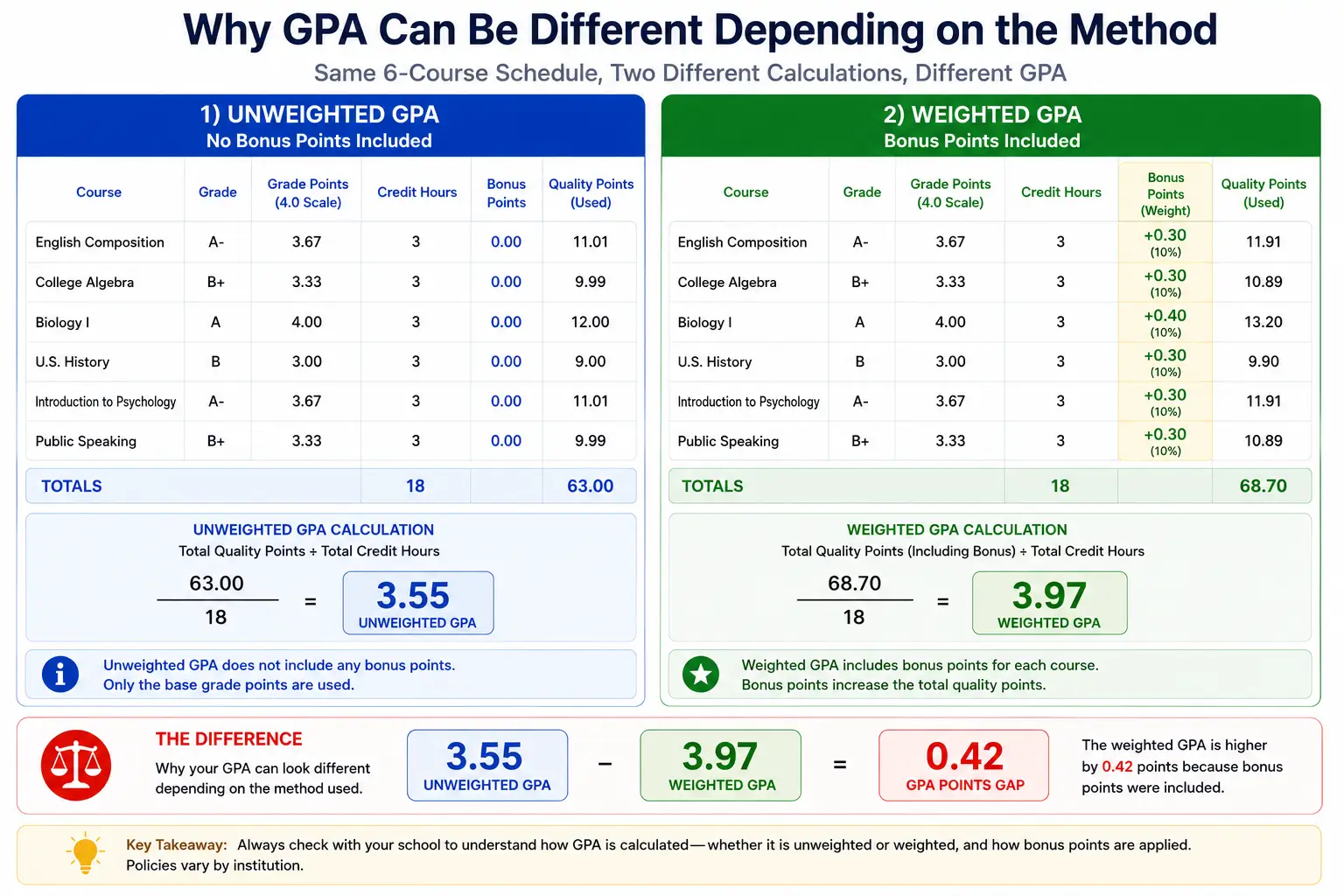
How a high school GPA calculator handles AP and Honors bonus points depends entirely on which scale the tool defaults to. According to standard college counseling practice, the most widely used system adds +0.5 for Honors and +1.0 for AP and IB, but this is a convention, not a national standard. Tools like GPACalculator.net, GPACalculator.io, and PathIvy's GPA Calculator each use variations of this default, and none of them warn users that their school may apply a different scale.
The Bonus Point Problem - Why Your Calculator's Default May Not Match Your School
This is the discrepancy that no competing calculator page addresses.
There is no federal or state standard for how high schools weigh GPA. The bonus point scale is set at the district or school level, and the variation is wide enough to produce meaningfully different GPA results for the same student on the same grades.
Weighted GPA with +1.0 for AP vs. weighted GPA with +0.6 for AP: schools using the standard +1.0 bonus produce a higher weighted GPA for the same grades than schools using +0.6. The key difference: a student using the wrong bonus scale on a calculator will overstate their GPA, and the error carries into every subsequent college research decision.
Which Bonus Scale Does Your School Use?
Quick Comparison
| Scale Type | Honors Bonus | AP / IB Bonus | Maximum Weighted GPA | Common In |
|---|---|---|---|---|
| Standard scale | +0.5 | +1.0 | 5.0 | Majority of U.S. public high schools |
| Reduced scale | +0.3 | +0.6 | ~4.6 | Some California and Southeast districts |
| Honors-only exclusion | +0 | +1.0 | 5.0 | Schools that only reward AP/IB rigor |
| Modified 5-point scale | varies | varies | 5.0 | Individual school board discretion |
Or maybe I should say: the GPA on your official school transcript is the number that gets reported to colleges. But when you're doing your own research, checking scholarship thresholds, and estimating competitiveness on college profiles, you need to calculate using your school's actual bonus values, not a calculator's assumption.
Your school counselor's office or your student handbook will list the exact weighting policy. A five-minute check there prevents a significant amount of confusion later.
Read More → How GPA is calculated differently in college vs. high school
Do Colleges Look at Weighted or Unweighted GPA?
The direct answer: it depends on the college, and the most selective schools don't use either number you calculated at home.
Many mid-tier and regional four-year colleges accept the GPA your transcript reports, typically your school-issued weighted figure. They may apply an internal conversion, but they're largely taking your school's number as given.
Selective and highly selective colleges do something different.
How Selective Colleges Recalculate Your GPA
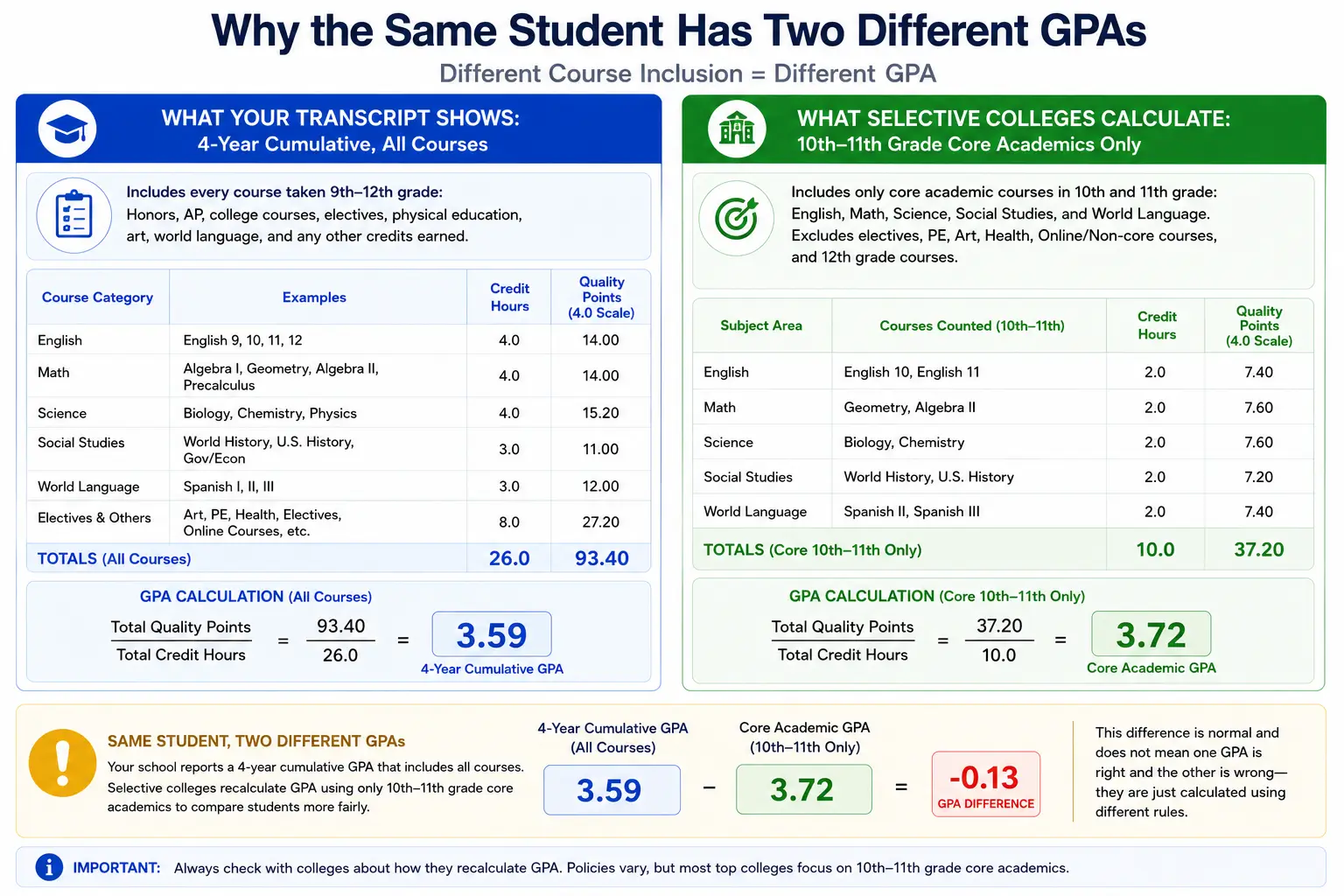
What most guides skip entirely and what all three named calculator competitors ignore is this: at many selective U.S. colleges, admissions staff recalculate every applicant's GPA from scratch using their own methodology.
That recalculation typically includes only:
10th and 11th grade courses
Core academic subjects (English, math, science, history/social studies, world language)
A standardized weighting system, not your school's
Freshman year is routinely excluded. PE, music, art, and general electives are stripped out. The result is a GPA built from two years of core academic performance only, and it will differ from everything on your transcript.
Look, if you're applying to selective schools and you've been tracking a 3.97 weighted GPA, here's what actually matters: calculate what your GPA looks like using only your 10th and 11th grade core academic courses on a standard +0.5/+1.0 scale. That figure is closer to what an admissions reader will evaluate.
According to Harvard University's 2024–25 Common Data Set, the average weighted GPA of enrolled first-year students was 4.21, a number that reflects high grades specifically in rigorous sophomore and junior year coursework, not a four-year cumulative average padded by electives or freshmen-year performance.
I've seen conflicting guidance on exactly which courses selective colleges include in recalculations. Some sources include all academic courses, others apply a threshold excluding anything below Honors level.
My read: Use your core academic courses from 10th and 11th grade as a floor estimate. If that calculation meets a school's published threshold, you're competitive on GPA. If it doesn't, the four-year weighted figure won't change that.
Learn More → Harvard University 2024–25 Common Data Set
What Is a Competitive High School GPA for College Admissions?
There is no universal answer. Context, school type, course rigor, and the specific college determine what "competitive" means for each application.
A practical reference framework:
- Weighted 4.0+ / Unweighted 3.7+ - competitive at selective colleges; expected range for highly selective (top 25) programs; required floor for most Ivy-adjacent applications
- Weighted 3.5–3.9 / Unweighted 3.2–3.6 - competitive at a broad range of four-year institutions; may fall short of honors programs or merit scholarships at flagship state universities.
- Weighted 3.0–3.4 / Unweighted 2.7–3.1 - eligible for most four-year schools; strong test scores or exceptional circumstances strengthen applications at selective programs.
- Below unweighted 3.0 - limits four-year selective options; community college transfer pathways or test-optional programs with holistic review may be better fits
Some college counselors argue that course rigor matters more than raw GPA, that a 3.6 unweighted GPA earned in a demanding AP-heavy schedule signals more to admissions offices than a 3.9 in standard-level courses.
That's genuinely true at schools with full holistic review processes that include school profile context. The counterpoint is that most automated scholarship systems and state honors program cutoffs apply a flat GPA threshold without any contextual adjustment. Both measures matter, for different purposes.
Read More → How to calculate your grade within a single course before it posts to your transcript