
How to Use a GPA Calculator
Last updated: May 2026
A GPA calculator computes your Grade Point Average by multiplying each course's letter grade value, called quality points, by its credit hours, summing all results, then dividing by total credit hours attempted. The output is a number on the 4.0 scale representing your weighted academic performance across all courses, not a simple average of letter grades.
You got your final grades. You converted each letter to a number, divided by the number of courses, and got something that doesn't match your registrar's portal. That's not a data error.
It's the wrong formula.
GPA is a weighted average weighted by credit hours. A 4-credit chemistry course counts twice as much as a 2-credit lab toward your GPA, and until you account for that difference, every calculation you've run has been producing a number that means nothing.
This guide covers the quality points formula with a full worked example, the discrepancy between A+ = 4.0 and 4.3 that your calculator may be handling incorrectly, how to compute a true cumulative GPA across semesters, and what actually happens to your GPA when you transfer schools.
This guide works best for standard U.S. semester-based GPA systems on the 4.0 scale. It doesn't cover quarter-system schools, international grade conversions, or graduate programs using pass/fail-only grading.
Why Your Letter Grade Average Is Not Your GPA
Here's the thing: letter grades and GPA points are not the same unit. You can't average them the way you'd average raw numbers unless you convert them first and then weight them by credit hours.
The method most students try converts A = 4, B = 3, C = 2, adds them up, and divides by the number of courses. That produces an unweighted average that assumes every course contributes equally to your GPA. But if you're carrying a 4-credit organic chemistry course alongside a 1-credit fitness elective, those two courses are not equal contributors. The formula has to reflect that.
Your GPA is total quality points earned divided by total credit hours attempted. Quality points are calculated per course: grade value × credit hours. A B in a 3-credit course contributes 9 quality points (3.0 × 3). An A in a 1-credit course contributes 4 quality points (4.0 × 1). The 3-credit B outweighs the 1-credit A.
Read More → Find the score you need to protect your GPA before grades post
Students who've run a plain letter-grade average often report their result sits 0.1 to 0.4 GPA points away from what the registrar shows, not because anything is wrong with their grades, but because unweighted averaging ignores the credit-hour multiplier entirely. That gap doesn't seem significant until you're at 3.18, trying to clear the 3.25 merit scholarship threshold.
How GPA is calculated on the 4.0 scale is a question that generates consistent search volume because the formula is rarely taught at orientation. The standard method multiplies each course's grade value by its credit hours to obtain quality points, then divides total quality points by total credit hours attempted.
According to NCES 2020 data cited by BestColleges in 2024, the average U.S. college GPA is 3.15, meaning most students cluster tightly in the B-to-B+ range, where a 0.1 difference can shift scholarship eligibility and competitive standing for graduate programs.
Why a simple letter-grade average gives the wrong GPA comes down to one overlooked variable: credit hours. Two students can carry identical letter grades across the same courses and end up with different GPAs if one took heavier credit loads in the courses where they scored lower. A C in a 4-credit required course does more damage to GPA than a C in a 1-credit elective, even though both show the same letter on the transcript. The weight doesn't cancel out. It compounds.
The GPA Formula: Quality Points × Credit Hours
The calculation has two levels. Per-course first, then total across courses.
Per-course: Quality Points = Grade Value × Credit Hours
Cumulative: GPA = Total Quality Points ÷ Total Credit Hours Attempted
That's the whole formula.
To calculate your GPA on the 4.0 scale, follow these steps:
- Convert each letter grade to its numeric grade value (A = 4.0, B = 3.0, C = 2.0, D = 1.0, F = 0).
- For +/− grades, use: A− = 3.7, B+ = 3.3, B− = 2.7, C+ = 2.3, C− = 1.7.
- Multiply each course's grade value by its credit hours to get quality points.
- Add all quality points across all courses.
- Divide total quality points by total credit hours attempted the result is your GPA.
(A+ requires a separate check; see the next section before entering that value.)
Worked Example With Real Courses and Credit Hours
Using a realistic first-semester schedule:
| Course | Grade | Grade Value | Credit Hours | Quality Points |
|---|---|---|---|---|
| English Composition | B+ | 3.3 | 3 | 9.9 |
| Calculus I | B− | 2.7 | 4 | 10.8 |
| Intro to Psychology | A | 4.0 | 3 | 12.0 |
| Discrete Math | A | 4.0 | 1 | 4.0 |
| Chemistry Lab | C+ | 2.3 | 2 | 4.6 |
| Total | 13 | 41.3 |
GPA = 41.3 ÷ 13 = 3.18
A plain letter-grade average of those five grades (3.3 + 2.7 + 4.0 + 4.0 + 2.3) ÷ 5 produces 3.26. The difference is 0.08 GPA points. That gap is large enough to determine eligibility for a merit scholarship at many institutions.
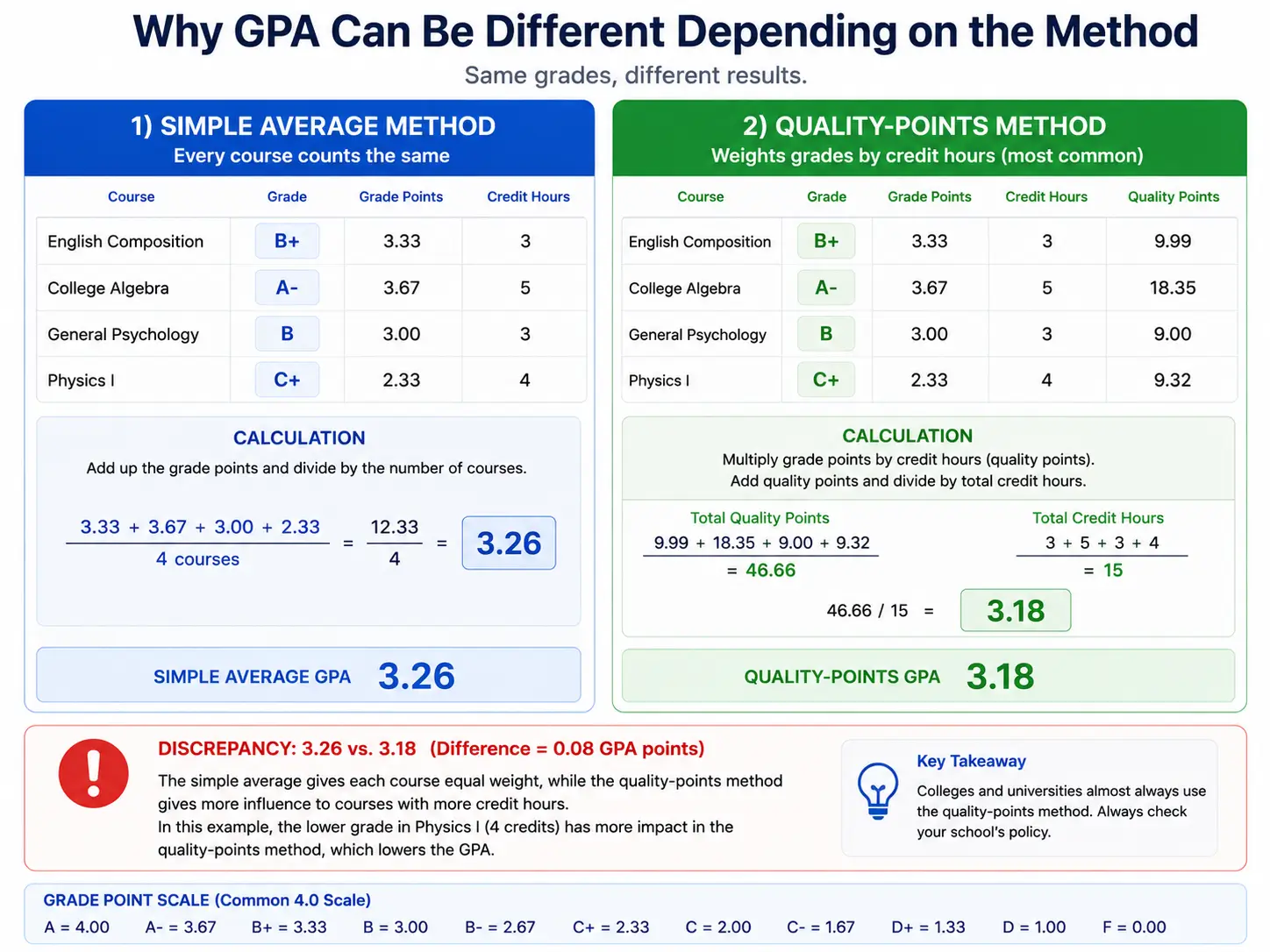
Using a GPA calculator that includes credit hours requires entering both the letter grade and the credit-hour value for each course, not just the grade. According to the standard 4.0 scale GPA methodology, defaulting every course to 3 credit hours is the most common input error users make with tools like Calculator.net GPA Calculator, GPACalculator.io, and GPACalculator.net, all of which list credit hours as a required field that many students skip or leave at the preset default, producing a result that looks plausible but is technically wrong.
The A+ Problem: 4.0 or 4.3?
No competing GPA calculator page explains this clearly. It deserves a direct answer.
Some U.S. institutions cap A+ at 4.0, treating it as equivalent to a standard A at the top of the scale. Others assign an A+ a value of 4.3, allowing students to exceed the traditional 4.0 ceiling with exceptional performance mathematically. Neither convention is universal, and the difference is not cosmetic.
A+ = 4.0 vs. A+ = 4.3 on the GPA scale: Institutions capping A+ at 4.0 create a clean ceiling, making GPA directly comparable across schools. Institutions assigning 4.3 allow high achievers to accumulate a GPA above 4.0 for consistently exceptional work. The key difference: if your school uses 4.3 and you enter 4.0 into your calculator, your GPA will be understated for every A+ you've earned, potentially by several hundredths of a point.
Which Schools Use 4.3 for A+?
Quick Comparison
| Convention | Best For | Key Benefit | Limitation |
|---|---|---|---|
| A+ = 4.0 (standard cap) | Cross-institutional comparison and grad school reporting | Clean ceiling; most graduate programs normalize to this scale | Students earning A+ receive no additional GPA credit above a standard A |
| A+ = 4.3 (extended scale) | Institutions that reward top-tier performance within courses | Allows GPA above 4.0 for consistently exceptional work | Creates confusion when comparing across schools; some grad programs convert back to 4.0 cap |
| No +/− distinctions | Simplified grading systems | Straightforward: A = 4, B = 3, C = 2, D = 1, F = 0 | Less granular; a B+ and a B− carry the same GPA value |
I've seen conflicting guidance on this. Some sources list only a handful of schools using 4.3; others list dozens, and there's no maintained central registry.
My read: don't assume your school uses either convention. Check your institution's academic catalog or registrar FAQ; the page will explicitly list the grade point value assigned to each letter grade, including A+. That's the only source that matters for your GPA.
Read More → Calculate your grade within a single course before it posts to your transcript
How to Calculate Cumulative GPA Across Semesters
Semester GPA and cumulative GPA use the same formula; the difference is scope.
Cumulative GPA pools every quality point and every credit hour from every semester you've completed.
Cumulative GPA = Total Quality Points Across All Semesters ÷ Total Credit Hours Attempted Across All Semesters
Or maybe I should say: treat all your semesters as one massive single-term calculation. Add every course's quality points together. Add every credit hour together. Divide.
What you cannot do is average your semester GPAs directly. If you earned a 3.5 in a 15-credit semester and a 3.0 in a 9-credit semester, your cumulative GPA is not 3.25. It's (52.5 + 27.0) ÷ 24 = 3.31. The heavier semester carries more weight.
That's a counterintuitive result. It's also correct.
The Transfer Credit Exception - What No Competitor Explains
This scenario affects millions of students annually and is absent from every competing calculator page.
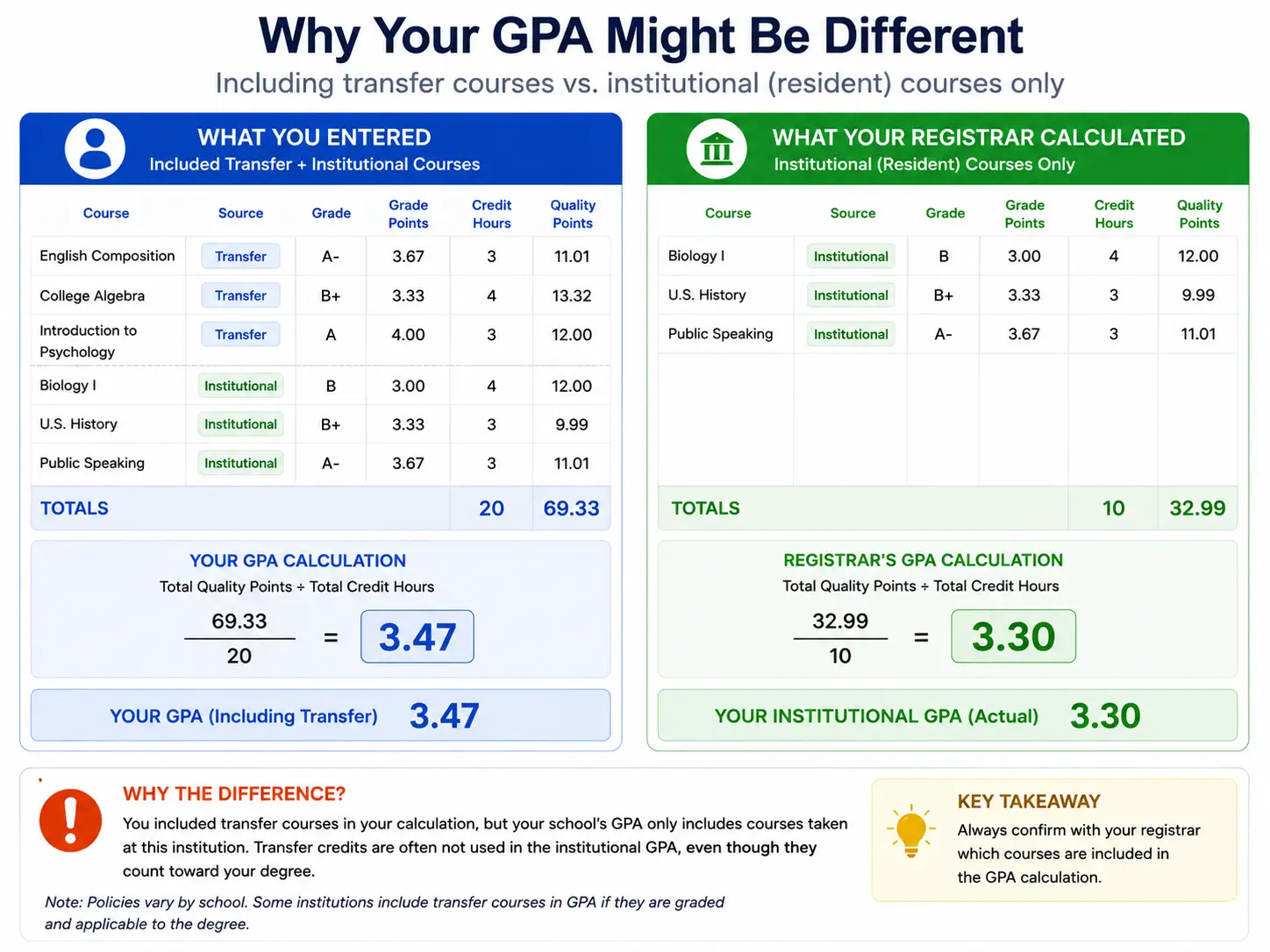
When you transfer to a new institution, your transfer credits typically appear on your new transcript as earned hours but without the grade attached. The grades you received at your previous school are almost always excluded from your new school's GPA calculation. Your cumulative GPA at the new institution starts from your first course taken there.
Look, if you're a transfer student and your GPA calculator result doesn't match your new registrar's official GPA, here's what's almost certainly happening: you've included transfer course grades in your formula. Your registrar hasn't. They're calculating GPA only from courses taken at their institution.
This distinction matters significantly for academic standing decisions, dean's list eligibility, and graduate school applications, where both your sending institution's GPA and your current GPA may be reviewed as separate figures.
Learn More → BestColleges 2024 citing NCES 2020 NPSAS data
What Is a Good GPA - And Where Do You Stand?
There is no universal threshold. Context determines what "good" means.
According to NCES 2020 data cited by BestColleges in 2024, the average U.S. college GPA is 3.15, with women averaging 3.20 and men averaging 3.09. Most students cluster in a band from roughly 2.9 to 3.4, meaning a difference of a few hundredths of a point can shift your standing relative to peers in a meaningful way.
Some educators argue that GPA benchmarks are overemphasized relative to course rigor, and that a 3.2 in a demanding engineering curriculum reflects more than a 3.7 in a less rigorous program. That's genuinely valid; many graduate admissions committees review GPA in the context of major and institution.
The counterpoint is that automated scholarship filters and employer applicant tracking systems typically apply flat cutoffs of 3.0, 3.25, or 3.5 without contextual adjustment. The benchmark matters at those gates, whether or not it reflects the full picture.
A practical reference frame for most U.S. undergraduate contexts:
- 3.5 and above - competitive for most merit scholarships and selective graduate programs
- 3.0–3.49 - eligible for most programs; may fall short of highly selective grad school thresholds
- 2.5–2.99 - meets most undergraduate requirements; limited scholarship access at this range
- Below 2.0 - academic probation territory at most institutions; requires immediate intervention
Read More → Use our average grade calculator to find the exact score you need in each course