
How to Use a College GPA Calculator
Last updated: May 2026
A college GPA calculator computes your Grade Point Average by multiplying each course's letter grade value by its credit hours to produce quality points, then dividing total quality points by total credit hours attempted. The result is a credit-weighted number on the 4.0 scale, not a simple average of your grades.
You got a C+ in your 4-credit chemistry course and an A in your 2-credit elective. You expected a rough semester, but your cumulative GPA dropped more than that felt fair. It wasn't a portal glitch.
The heavier course hit twice as hard. That's not intuitive until you've seen the formula written out.
GPA isn't an average of your letter grades; it's a weighted average, with credit hours acting as the weights. A single bad grade in a 4-credit required course does more damage than two bad grades in 1-credit electives, because the formula reflects how much of your academic load each course actually represents.
This guide explains the quality points calculation with a real mixed-credit example, the semester vs. cumulative GPA difference that quietly costs students merit scholarships every semester, and what actually happens to your GPA when you retake a failed course, an outcome that depends entirely on your school's policy and can shift your GPA by a quarter point in either direction.
This guide covers standard U.S. semester-based college GPA systems on the 4.0 scale. It doesn't address pass/fail courses, quarter-system schools, or international grade conversions.
Why a Heavy-Credit Course Hit Your GPA Harder Than You Expected
Here's the thing: every credit hour you attempt becomes part of the denominator in your GPA formula. The bigger the course, the more force it exerts on the final calculation in both directions.
A student who earns an A (4.0) in a 4-credit course gains 16 quality points. The same A in a 1-credit course gains 4. Same letter grade. Four times the GPA impact. Flip that to a C+ (2.3) in the 4-credit course, and the quality point deficit relative to an A is 6.8 points, a gap that a strong performance in a 2-credit elective simply cannot close.
The single most common GPA surprise students encounter: a high grade in a small course cannot rescue a low grade in a large course. A 4-credit course is pulling in one direction with four times the force of a 1-credit course. Students who've tried averaging letter grades directly often report that their result is noticeably higher than the registrar's GPA, specifically when a low grade came in a high-credit course. The discrepancy feels like an error.
It isn't.
Read More → Find the exact score you need in each course before grades post
Why credit hours change your GPA calculation fundamentally is something most grade guides demonstrate only abstractly. Quality points, the product of grade value and credit hours, are the actual units your GPA is built from. According to NCES 2020 data cited by BestColleges in 2024, the average U.S. college GPA is 3.15, and students cluster tightly in a narrow range, meaning one low-grade semester in heavy-credit courses can push a student below key thresholds in a single term, before they've had time to respond.
Why a C+ in a 4-credit course hits harder than a C+ in a 2-credit course is purely proportional. A C+ (2.3) in a 4-credit course produces 9.2 quality points. The same grade in a 2-credit course produces 4.6. The GPA impact is exactly double because the formula multiplies grade value by credit hours before dividing, not after. Students who've never seen this written out assume grades contribute equally to GPA regardless of course size, which is the source of nearly every "my calculator doesn't match my transcript" complaint.
How to Calculate College GPA With Credit Hours - Step by Step
The calculation works at two levels. Per course first, then combined across all courses.
Per-course: Quality Points = Grade Value × Credit Hours
GPA: Total Quality Points ÷ Total Credit Hours Attempted
To calculate your college GPA with credit hours, follow these steps:
- Assign each letter grade its grade value: A = 4.0, B = 3.0, C = 2.0, D = 1.0, F = 0.
- For +/− grades use: A− = 3.7, B+ = 3.3, B− = 2.7, C+ = 2.3, C− = 1.7.
- Multiply each course's grade value by its credit hours to get quality points.
- Add all quality points together across every completed course.
- Divide total quality points by total credit hours attempted; that number is your GPA.
(Check your academic catalog for your school's A+ value; some use 4.0, others 4.3. Using the wrong one will skew every semester where you earned an A+.)
Worked Example: Mixed Credit Hours, Real Grades
Using the exact scenario from above, extended to a full, realistic semester:
| Course | Grade | Grade Value | Credit Hours | Quality Points |
|---|---|---|---|---|
| Chemistry (4-credit STEM) | C+ | 2.3 | 4 | 9.2 |
| English Composition | B+ | 3.3 | 3 | 9.9 |
| Intro to Sociology | B | 3.0 | 3 | 9.0 |
| Music Appreciation (elective) | A | 4.0 | 2 | 8.0 |
| PE / Wellness | A | 4.0 | 1 | 4.0 |
| Total | 13 | 40.1 |
Semester GPA = 40.1 ÷ 13 = 3.08
A simple letter-grade average of those five grades (2.3 + 3.3 + 3.0 + 4.0 + 4.0) ÷ 5 produces 3.32. The gap is 0.24 GPA points, entirely because the 4-credit chemistry course pulled the weighted result down.
That 0.24 difference is the distance between a 3.08 (below most scholarship thresholds) and a 3.32 (above them). The simple average was producing false security.
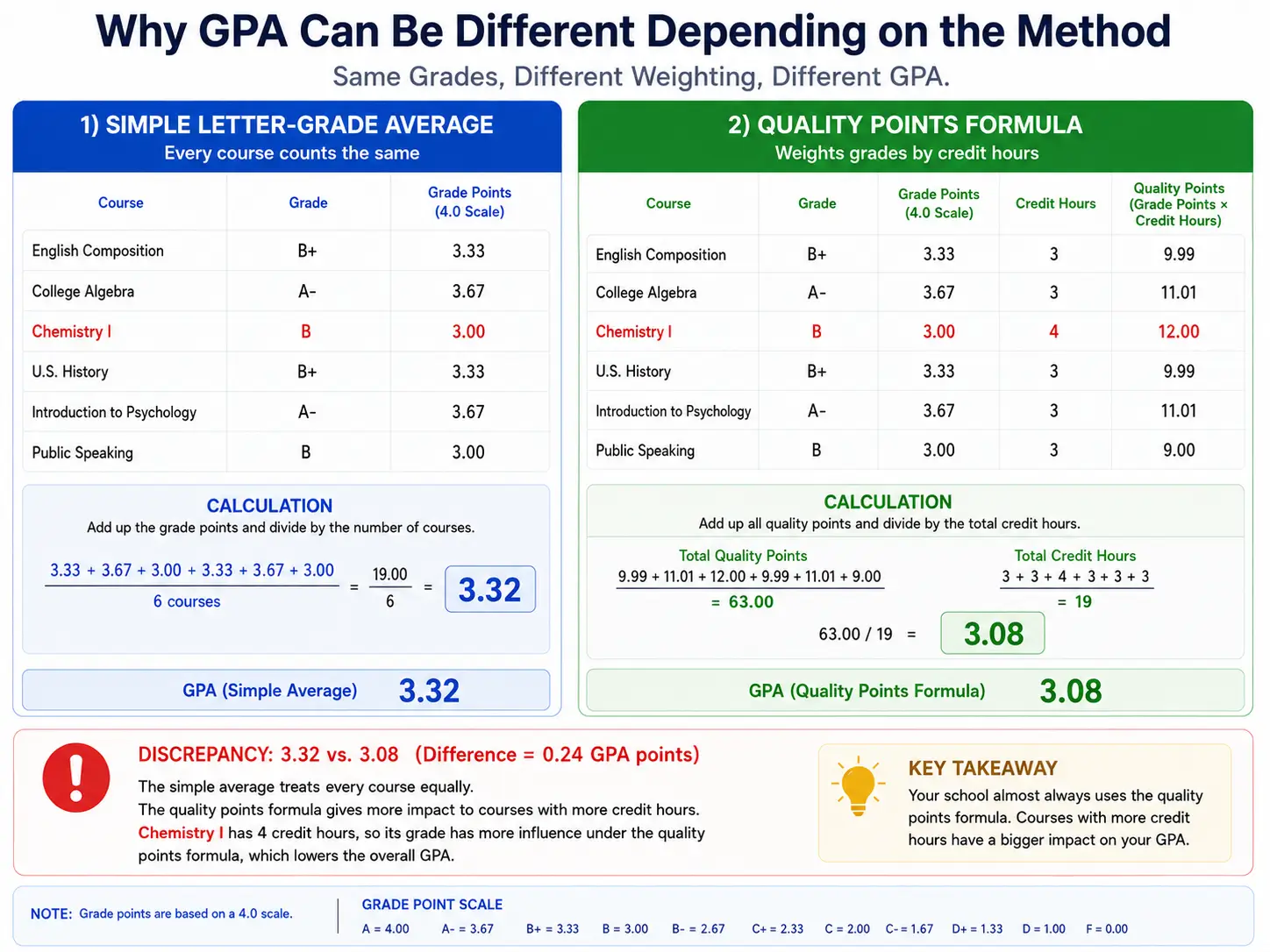
Using a college GPA calculator with letter grades and credit hours requires entering both the grade and the credit value for each course, not just the letter grade. Tools like GPACalculator.net, Calculator.net GPA Calculator, and GPACalculator.io all include a credit hours field that many students skip or leave at the preset default of 3. Entering every course at 3 credits when your schedule includes 1-, 2-, and 4-credit courses produces a number that looks reasonable but doesn't match your transcript.
Semester GPA vs. Cumulative GPA
This distinction does more quiet damage to students than almost any other GPA misconception, and none of the three major calculator competitors address it.
Your semester GPA measures only the courses from one term and resets with each new semester. Your cumulative GPA is the running total of all terms at your current institution, weighted by credit hours.
Semester GPA vs. cumulative GPA for scholarship retention: Semester GPA reflects one term's performance and resets each semester. Cumulative GPA is the long-running weighted total across all completed terms. The key difference: most merit scholarships require a minimum semester GPA for each term, not just a cumulative threshold, meaning one difficult semester can trigger a scholarship warning even when your cumulative GPA remains above the required floor.
The Scholarship Floor Most Students Never Read
Quick Comparison
| Scenario | Semester GPA | Cumulative GPA | Scholarship Status |
|---|---|---|---|
| Strong history, weak current term | 2.7 this term | 3.2 overall | At risk — many scholarships require 3.0+ per semester regardless of cumulative standing |
| Weak start, strong recovery | 3.4 this term | 2.85 overall | Cumulative risk — overall standing may trigger probation or financial aid review |
| Consistent across all terms | 3.1 this term | 3.1 overall | Meets most standard thresholds on both measures |
| Recovering from one failed course | 3.0 this term | 2.95 overall | Borderline — outcome depends on grade forgiveness vs. averaging policy |
Some financial aid advisors argue that scholarship GPA requirements are applied with flexibility, that one bad semester triggers a warning rather than immediate funding loss. That's valid at institutions with formal academic appeal processes written into their scholarship policies.
The counterpoint is that many private and institutional scholarships state the semester GPA requirement as non-negotiable in the award letter, with automatic suspension after one failing term. Read your award letter, not just the scholarship webpage's headline requirements.
Or maybe I should say: your cumulative GPA is the number you see every time you check. The semester GPA floor buried in your award letter is the one that can actually remove your funding.
Read More → How to calculate your course grade before it posts to your transcript
What Happens to Your GPA When You Retake a Failed Course?
This is the question no competitor page addresses, and it's one of the highest-stakes GPA decisions a student makes.
The answer depends entirely on your institution's policy. There are two systems, and they produce very different outcomes.
Grade Forgiveness vs. Grade Averaging
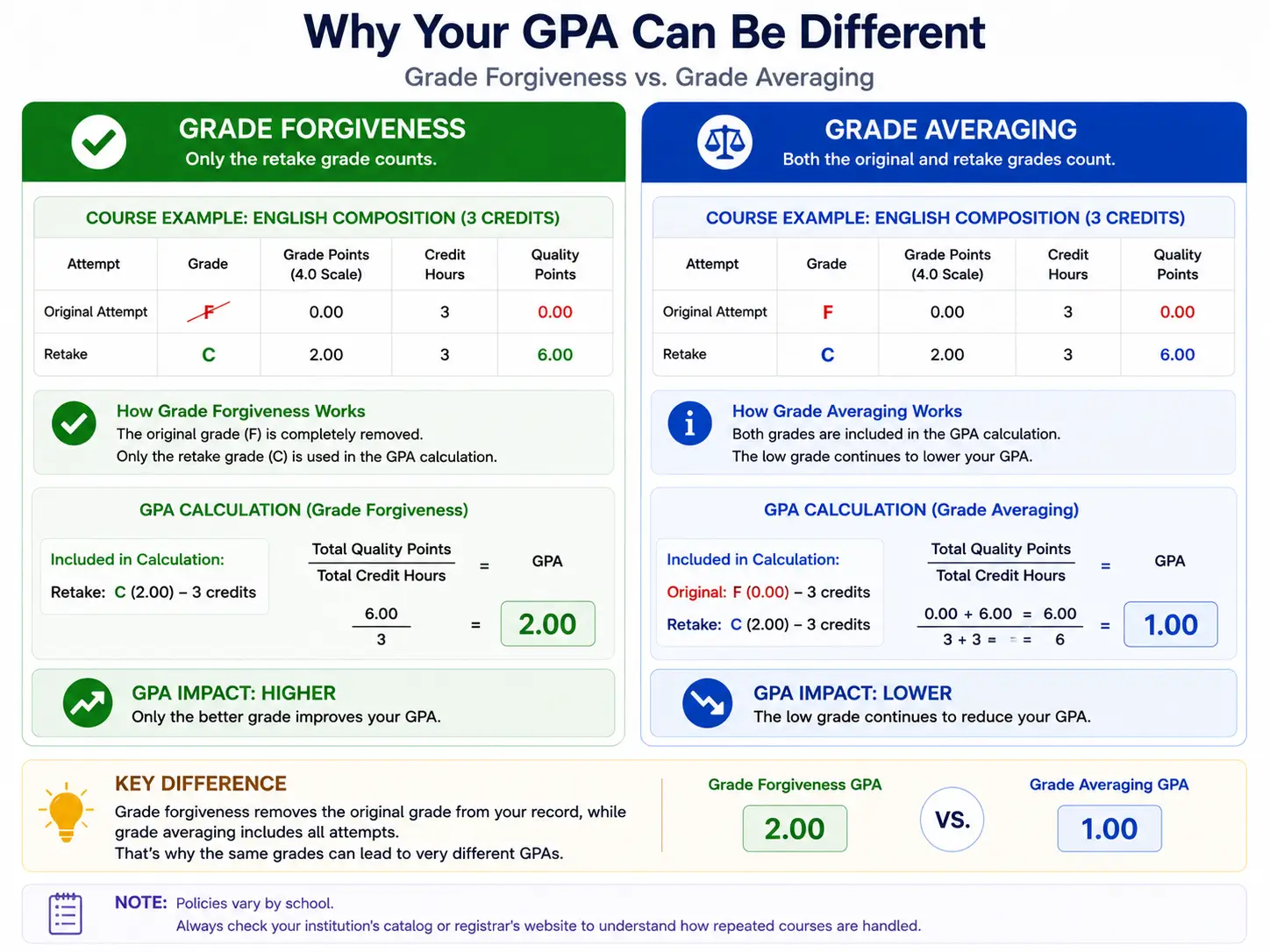
Grade forgiveness (also called grade replacement): The original grade is replaced in the GPA calculation. It may still appear on the transcript visually, but it no longer contributes quality points. Most students assume all retakes work this way.
They don't.
Grade averaging: Both the original grade and the retake grade are included in the quality points calculation. You earn the credit hours once, but both grades affect your cumulative GPA. A retake under this policy still helps, but proportionally less. Replacing an F with a C improves your quality point total, but the F's damage isn't erased, only diluted.
Look, if you're retaking a course to fix your GPA, here's what actually determines the outcome: search your registrar's website or academic catalog for the specific phrase "grade forgiveness," "grade replacement," or "academic renewal." Those terms signal a replacement policy. If you find only "repeat course policy" with language about including all attempts, that's grade averaging, and your GPA improvement will be significantly smaller than you're expecting.
I've seen conflicting language on this within the same institution's published materials; the academic catalog sometimes describes one policy while the financial aid FAQ implies another. My read: call the registrar directly and ask for the policy in writing. That conversation takes ten minutes and can clarify a decision that follows your GPA for years.
Learn More → Source for the 20% academic probation rate among first-year college students
Academic Probation and the 2.0 Floor
Twenty percent. That's the share of first-year college students who end up on academic probation, according to AccreditedSchoolsOnline (2025).
The trigger at nearly every U.S. institution is a cumulative GPA below 2.0. Academic probation is a formal status; it typically doesn't appear on external transcripts, but it comes with conditions: a minimum GPA requirement for the following semester, mandatory academic advising, and sometimes enrollment restrictions on future terms. A second consecutive semester below 2.0 commonly results in academic suspension.
What most GPA guides skip: a student can hold a cumulative GPA above 2.0 and still be placed on probation if their semester GPA drops below 2.0 in a single term. The cumulative figure provides longer-term protection. The semester floor is the more immediate trigger at many schools.
The practical implication: if your current semester is going badly, project your semester GPA using the formula above before final grades are posted. A projected semester GPA below 2.0, even with a healthy cumulative GPA, is worth addressing with an academic advisor immediately, when options like late withdrawals may still prevent the outcome.
Read More → How GPA is calculated on the 4.0 scale