
How to Use a Cumulative GPA Calculator
Last updated: May 2026
A cumulative GPA calculator computes your overall Grade Point Average by dividing total quality points by the grade value multiplied by its credit hours, summed across all semesters by total credit hours attempted. It produces a single number representing your full academic record, not a simple average of semester GPA figures.
You had three solid semesters. Then one rough one. You added up your four semester GPAs, divided by four, and got something close to but not exactly what your registrar is now showing.
That gap isn't a portal error. It's a formula error.
Averaging semester GPAs assumes every term carries the same credit hours. Most don't. A rough semester on 15 credits pulls your cumulative GPA down more than a rough semester on 9 credits, because the formula weights each term by the number of credit hours attempted. The simple average ignores that entirely.
This guide covers the cumulative GPA formula with a full four-semester worked example using the exact scenario above, explains the W grade vs. F grade distinction that affects your cumulative GPA trajectory in ways most students don't anticipate, and shows the reverse calculation no competitor page provides: what semester GPA do you need this term to bring your cumulative GPA up to a target?
This guide works best for U.S. semester-based undergraduate and graduate GPA systems on the 4.0 scale. It doesn't cover quarter-system schools, pass/fail-only programs, or transfer credit inclusion policies.
Why Averaging Your Semester GPAs Gives the Wrong CGPA
Here's the thing: a semester GPA is already a weighted average of quality points from that term divided by that term's credit hours. When you average several semester GPAs without accounting for term size, you're averaging pre-divided results and losing the original credit hour information entirely.
Two students can have identical semester GPA sequences 3.6, 3.7, 3.5, 3.1, and end up with different cumulative GPAs if their credit hour loads differed. The student who took 15 credits in the rough semester gets a lower cumulative GPA than the student who took 9 credits in that same rough semester. Same grades. Different weight.
The only correct method is to return to the raw numbers: total quality points earned across all semesters divided by total credit hours attempted across all semesters.
Students who've averaged their semester GPAs often report their result sits above their registrar's figure, specifically when the low-GPA semester carried more credits than the high-GPA semesters. The reverse can happen too, but the overestimate direction is more common because heavier credit loads tend to arrive in later semesters when course difficulty increases.
Read More → Find the score you need in each course before final grades post and affect your cumulative GPA
The cumulative GPA is calculated by pooling all quality points before dividing, not by averaging semester GPAs. A B in a 4-credit course contributes 12 quality points; a C in the same course contributes 8. According to the University of Georgia Graduate School (March 2025), all graduate students must maintain a 3.0 cumulative GPA for good academic standing and graduation eligibility, a threshold shared by the majority of U.S. graduate programs.
Why a bad semester doesn't ruin cumulative GPA as fast as students fear comes down to denominator size. Because cumulative GPA divides total quality points by total credit hours attempted, each new term adds to both the numerator and the denominator. A student with 90 completed credits absorbs a rough semester far better than one with only 15; the denominator is six times larger, and the damage is proportionally diluted.
The Cumulative GPA Formula - Step by Step
The formula is the same whether you're calculating across two semesters or ten. Scope doesn't change the method.
Cumulative GPA = Total Quality Points Across All Semesters ÷ Total Credit Hours Attempted Across All Semesters
To reconstruct quality points from a known semester GPA: Quality Points (that semester) = Semester GPA × Credit Hours That Semester.
To calculate your cumulative GPA across all semesters, follow these steps:
- For each semester, multiply the semester GPA by that term's credit hours to get quality points.
- Add all semester quality point totals together.
- Add all semester credit hour totals together.
- Divide total quality points by total credit hours the result is your cumulative GPA.
(If you have individual course grades, use grade value × credit hours per course for greater precision.)
Worked Example: Four Semesters, Exact Numbers
Using the scenario above, three strong semesters followed by one rough one, all on 15 credits:
| Semester | GPA | Credit Hours | Quality Points (GPA × Credits) |
|---|---|---|---|
| Semester 1 | 3.6 | 15 | 54.0 |
| Semester 2 | 3.7 | 15 | 55.5 |
| Semester 3 | 3.5 | 15 | 52.5 |
| Semester 4 (rough) | 3.1 | 15 | 46.5 |
| Totals | 60 | 208.5 |
Cumulative GPA = 208.5 ÷ 60 = 3.475, which rounds to 3.47 exactly what the registrar shows.
The simple average of (3.6 + 3.7 + 3.5 + 3.1) ÷ 4 also produces 3.475 and rounds identically here, because all four semesters carried identical credit hours. Equal credit loads are the one scenario where the simple average and the correct formula agree. When they differ, the simple average diverges, and the direction of the error depends on which semesters held the heavier loads.
That's why the method matters even when the numbers appear to match.
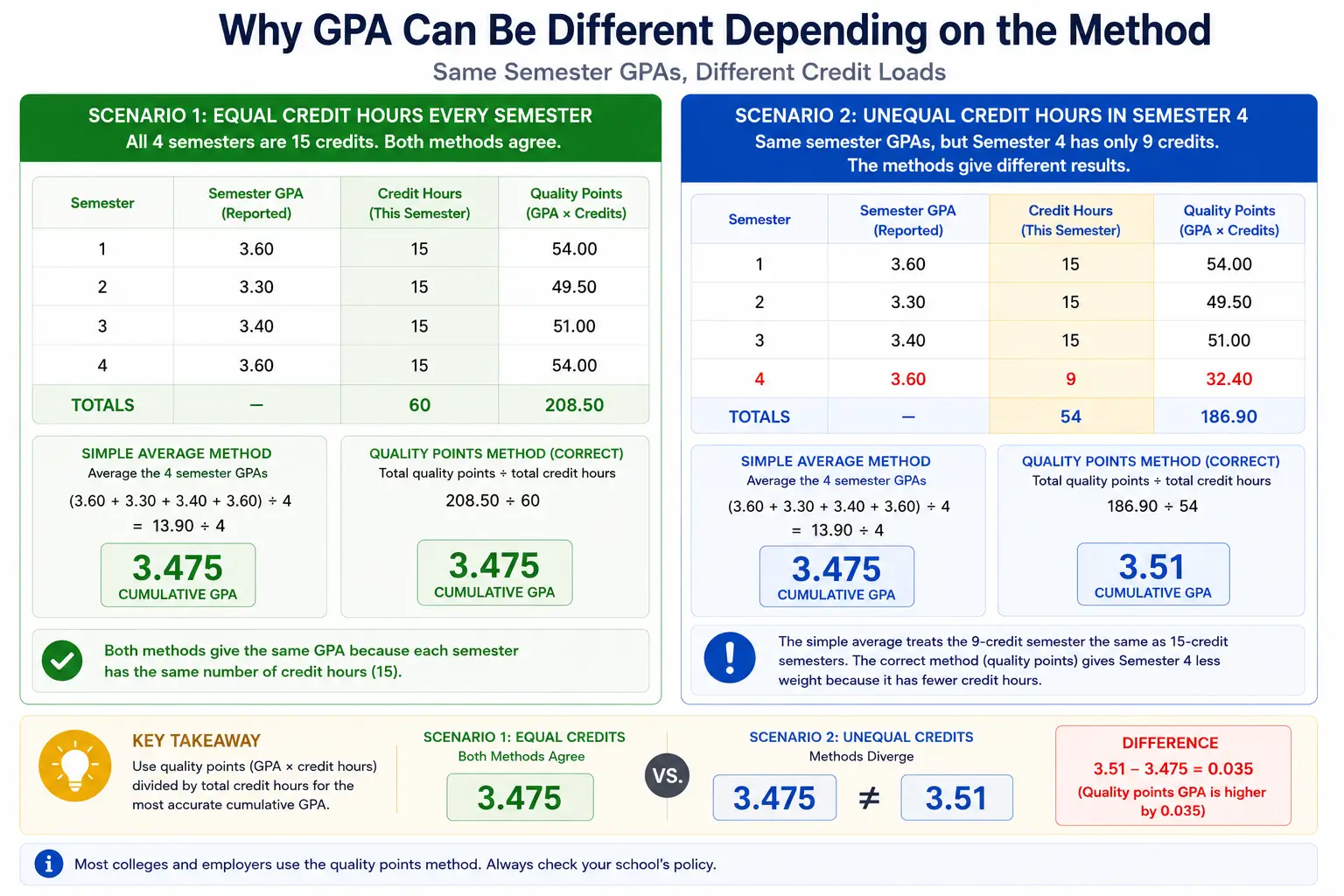
How to use a cumulative GPA calculator with previous GPA and credit hours requires entering both values for every prior semester, not just the most recent term. Tools like GPACalculator.io, GPACalculator.net, and the University of Maryland's Testudo GPA Calculator support multi-semester input but require accurate credit hours for each term. Entering a default or estimated value distorts your result.
W Grade vs. F Grade - How Each One Affects Your Cumulative GPA
This is the distinction all four competitor pages miss, and it directly changes how you should interpret your GPA trajectory.
When a student withdraws from a course after the add/drop deadline, they receive a W (Withdrawal). When a student fails to complete a course, they receive an F.
Both appear on the transcript. Both mean the course wasn't completed. Their effect on cumulative GPA is completely different.
W grade vs. F grade impact on cumulative GPA: A W adds 0 quality points and 0 credit hours to the GPA calculation, leaving cumulative GPA unchanged. An F adds 0 quality points but counts the credit hours as attempted, lowering cumulative GPA. The key difference: a W is GPA-neutral; an F actively damages it by inflating the denominator without adding any numerator value.
Understanding the GPA Impact of Each Grade Outcome
Quick Comparison
| Grade Outcome | Quality Points Added | Credit Hours Counted | GPA Impact | When to Consider |
|---|---|---|---|---|
| W (Withdrawal) | 0 | 0 | None - cumulative GPA unchanged | When failing is likely and the withdrawal deadline hasn't passed |
| F (Failure) | 0 | Full credit hours attempted | Lowers cumulative GPA permanently unless grade forgiveness applies | When withdrawal deadline has passed; damage is immediate |
| Incomplete (I) | 0 temporarily | 0 temporarily | Deferred - converts to F if not resolved by deadline | When work is completable within the extension window |
| Grade Forgiveness Retake | Original removed | Only retake counted | Removes original damage if school policy allows | Verify policy before assuming - not all schools offer this |
Some academic advisors argue that withdrawing is always preferable to risking an F. That's valid when the student has genuinely lost the ability to pass, and the deadline is still open. The counterpoint is that a pattern of W grades can trigger financial aid Satisfactory Academic Progress (SAP) reviews, raise questions in selective graduate program applications, and, at schools that count attempted hours for maximum credit limits, reduce your future enrollment flexibility. The decision isn't purely about GPA.
Or maybe I should say: a W protects your GPA number. A transcript full of W grades can raise questions that a strong GPA alone won't answer.
Learn More → The 3.0 cumulative GPA requirement for graduate student standing and graduation eligibility
What Semester GPA Do You Need to Hit a Target Cumulative GPA?
This is the calculation no competitor page includes, and it's the most emotionally urgent version of this search.
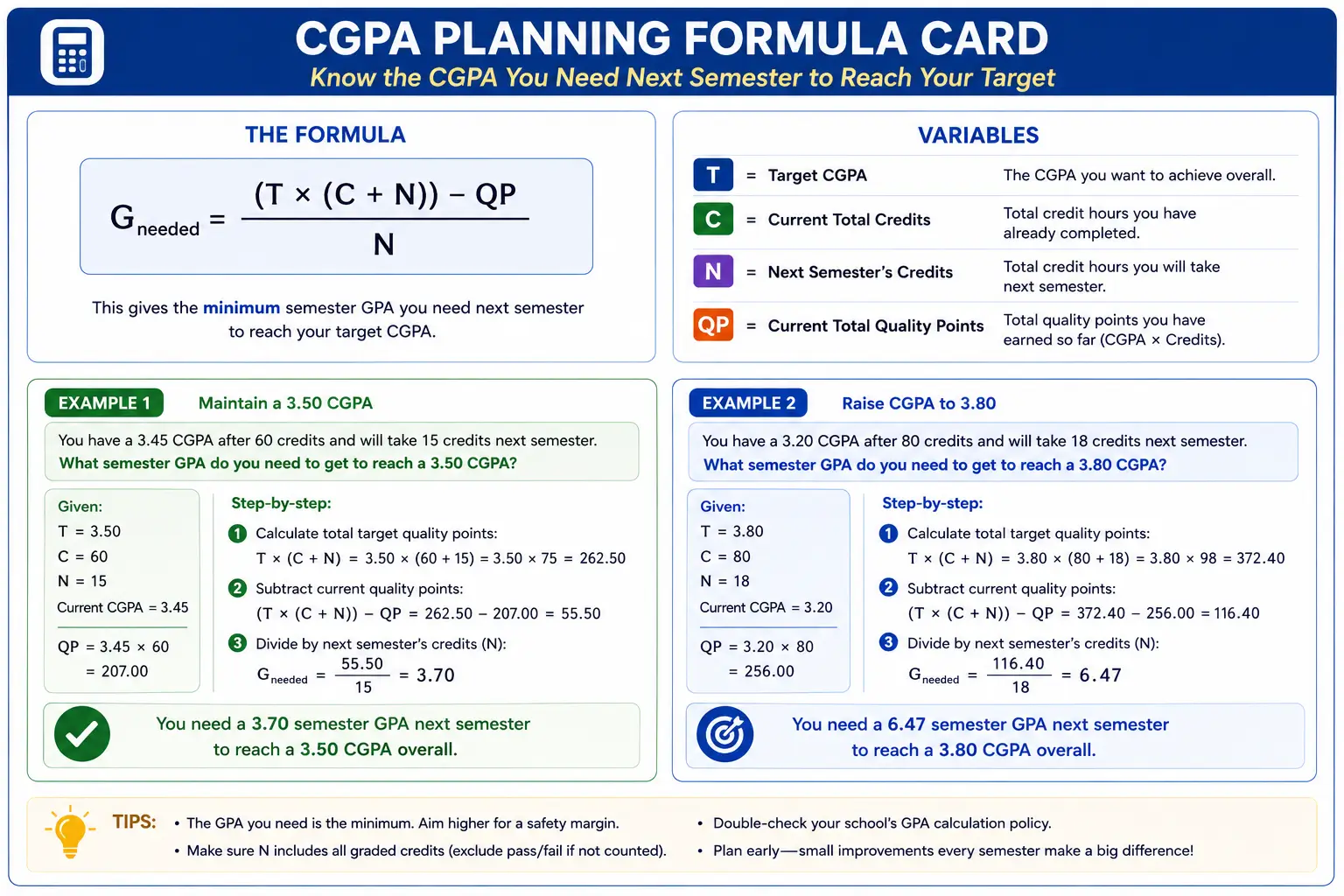
Required Semester GPA = ((Target CGPA × (Current Credits + Next Credits)) − Current Quality Points) ÷ Next Semester's Credits
Using the example above: cumulative GPA 3.47 on 60 credits (208.5 quality points), target 3.5, planning 15 credits next semester.
Required = ((3.5 × 75) − 208.5) ÷ 15 = (262.5 − 208.5) ÷ 15 = 54.0 ÷ 15 = 3.60
A 3.60 semester GPA on 15 credits brings the cumulative GPA from 3.47 to exactly 3.50.
For the more common emergency question, what do I need to protect a 3.0 cumulative standing?
Required for 3.0 = ((3.0 × 75) − 208.5) ÷ 15 = (225 − 208.5) ÷ 15 = 16.5 ÷ 15 = 1.10
A 1.10 semester GPA on 15 credits is enough to maintain a 3.0 cumulative when you're starting from 3.47. The buffer is significantly larger than most students in that situation realize, which is worth knowing before the panic sets in.
Look, if you're mid-semester and worried about dropping below 3.0, here's what actually helps: run this reverse calculation before final grades post, not after. A projected semester GPA that falls below the required floor is the signal to act; talk to your advisor about late withdrawals, incompletes, or workload adjustments while those options still exist.
Read More → How a single semester's GPA is calculated before it feeds into your cumulative record
The 3.0 Floor: Why Cumulative GPA Matters More Than Any Single Semester
The 3.0 cumulative GPA threshold is the single most consequential number for students planning graduate school. According to the University of Georgia Graduate School (policy updated March 12, 2025), all graduate students must maintain a cumulative GPA of 3.0 or higher for good academic standing and graduation eligibility, a requirement shared by the majority of U.S. graduate programs, including Ohio State, the University of Washington, and UConn.
I've seen conflicting guidance on whether undergraduate cumulative GPA floors operate on the same 3.0 standard. Some institutional policies set the undergraduate probation floor at 2.0, while others distinguish between satisfactory academic standing (typically 2.0) and scholarship or honors program eligibility (typically 3.0 or higher).
My read: the 2.0 floor is where academic probation begins for most undergraduates. The 3.0 threshold is where graduate program eligibility and most competitive merit scholarships start. They're different gates, and which one matters depends entirely on where you're headed.
What most guides skip: the 3.0 requirement for graduate programs applies at the point of application, not just during enrollment. A student applying with a 2.95 cumulative GPA to programs requiring a 3.0 floor will typically need to explain the shortfall, raise it before applying, or target programs with lower minimums. Being just above 3.0 at application time is not the same academic position as being comfortably above it, and that difference is worth tracking semester by semester, not just before senior year.