|
Getting your Trinity Audio player ready...
|
Understanding letter grade scale is crucial for every student’s academic success. Grades show how well someone is doing in school and help track progress over time. When students know what their percentages mean in letter form, they can set better goals and work toward improvement.
Many students get confused when trying to convert scores to grades. A test score of 87% might mean different things at different schools. Some schools call it a B+, while others might label it just a B. This confusion makes it hard to know exactly where you stand academically.
This guide will teach you everything about letter grade conversions. You’ll learn how to quickly turn any percentage into a letter grade. You’ll discover helpful calculator tools that make the process easy. By the end, converting grades will feel simple and natural.

What is a Letter Grade Scale?
A letter grade scale is a system schools use to show student performance. Instead of seeing numbers, students get letters like A, B, C, D, or F. These letters communicate how well someone did on assignments, or in overall classes.
Schools use letter grades because they’re easy to understand. Parents, students, and teachers all know that an A means excellent work. A C shows average performance. An F indicates failing work. This common language helps everyone discuss academic progress clearly.
Letter grades are important for tracking progress throughout the school year. Students can see if they’re improving or if they need extra help. Teachers use letter grades to identify which students need support. Colleges look at letter grades when reviewing applications. A strong grade history opens doors to better opportunities.
Understanding Percentages to Letter Grades
How Letter Grading to Percentage Works
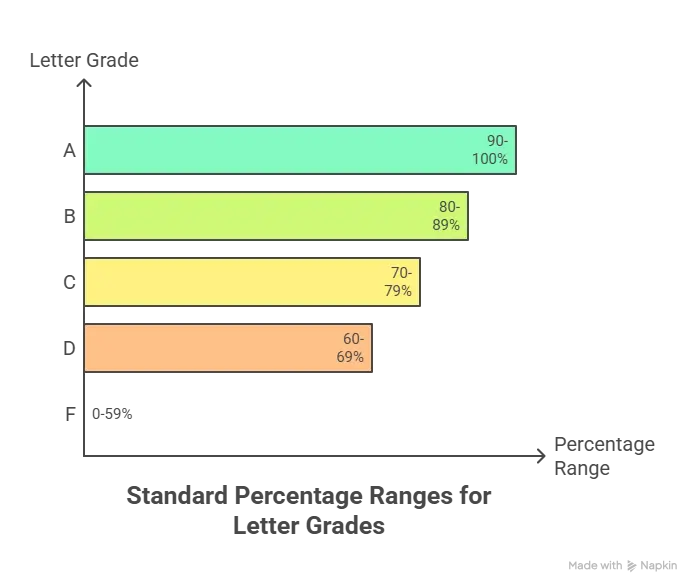
The letter grading to percentage conversion follows a simple process. First, calculate what percentage of points a student earned. Then, match that percentage to the corresponding letter grade range. Most schools use standard ranges that everyone follows.
Here are the standard percentage ranges for each letter:
- A = 90% to 100%
- B = 80% to 89%
- C = 70% to 79%
- D = 60% to 69%
- F = Below 60%
These ranges matter because they set clear expectations. Students know they need to score at least 90% to earn an A. If someone gets 88%, that’s a B. Clear ranges help students set specific goals. They can see exactly what they need to achieve.
Common Percentage Grade to Letter Grade Conversions
Understanding percentage grade to letter grade conversions helps students interpret their scores. Let’s break down each grade level with specific examples.
A Grade Percentage Breakdown (90-100%):
- 97-100% = A+
- 93-96% = A
- 90-92% = A-
An A shows excellent understanding of the material. Students earning As demonstrate strong study habits and consistent effort.
B Grade Percentages (80-89%):
- 87-89% = B+
- 83-86% = B
- 80-82% = B-
B grades indicate good performance. Students understand most of the material but might miss some advanced concepts.
C, D, and F Grade Ranges:
- C = 70-79% (Average work, basic understanding)
- D = 60-69% (Below average, struggling with material)
- F = Below 60% (Failing, significant gaps in understanding)
Knowing these ranges helps students quickly identify where they stand and what improvement looks like.
Using a Letter Grade Calculator
How a Letter Grade Calculator Helps
A letter grade calculator is an online tool that instantly converts percentages to letter grades. Students simply enter their score, and the calculator does all the work. These tools save time and eliminate confusion about grade conversions.
The benefits of using online calculators are significant. They’re fast and accurate. Students don’t need to memorize conversion charts or do mental math. Calculators handle complex weighted grades where different assignments count for different amounts. They also show what scores are needed on future tests to reach grade goals.
Time-saving advantages make calculators essential for busy students. Instead of spending minutes figuring out conversions, students get instant answers. They can check multiple scores quickly. This efficiency helps students focus more on studying and less on calculating.

Accuracy in grade tracking matters for academic planning. Calculator tools eliminate human error. Students can trust the results when making decisions about study priorities. Accurate tracking helps identify which classes need more attention.
Finding the Right Percentage to Letter Grade Calculator
When looking for a percentage to letter grade calculator, students should seek specific features. The best calculators are easy to use with clear input fields. They should support different grading scales since schools vary in their systems. Good calculators show both letter grades and GPA equivalents.
Free calculator options are widely available online. Many educational websites offer basic conversion tools at no cost. School district websites often provide calculators customized to their specific grading policies. Students don’t need to pay for these helpful resources.
Mobile vs desktop tools each have advantages. Mobile calculators work great for quick checks between classes or while studying. Desktop versions often have more features and larger displays for detailed grade tracking. Many modern calculators work well on both platforms.
Popular Letter Grades Calculator Tools
Letter Grade Average Calculator Features
A letter grade average calculator helps students combine grades into one overall score. This tool is especially useful when calculating semester or year-end grades. Students can input all their assignment, quiz, and test scores to see their current standing.
Calculating multiple grades requires adding up all letter grade values and dividing by the number of grades. However, this gets tricky because letters need conversion to numbers first. That’s where calculators become essential.
Averaging letter grades works through a simple process. First, convert each letter to its numerical equivalent (A=4.0, B=3.0, C=2.0, etc.). Next, add all these numbers together. Finally, divide by the total number of grades. The result shows the average GPA.

Using an average letter grades calculator simplifies this entire process. Students just type in their letter grades. The calculator handles all conversions and math automatically. Within seconds, students see their accurate grade point average.
Best Letter Grades Calculator Options
The best letter grades calculator tools share common qualities. Top-rated free calculators include those offered by major educational websites. These tools have been tested by millions of students and deliver accurate results.
User-friendly interfaces make the difference between good and great calculators. The best ones have clear labels for each input field. They provide helpful examples showing how to enter information. Error messages guide users when something is entered incorrectly. Clean designs avoid clutter and confusion.
Additional features to consider include:
- “What-if” calculators that predict future grades
- Support for weighted assignments
- GPA calculation alongside letter grades
- Print-friendly result pages
- Mobile-responsive designs
- Save features for tracking over time
Students should test other calculators to find one that matches their needs and comfortable to use.
Converting Letter Grades by Percentage
Quick Reference Guide
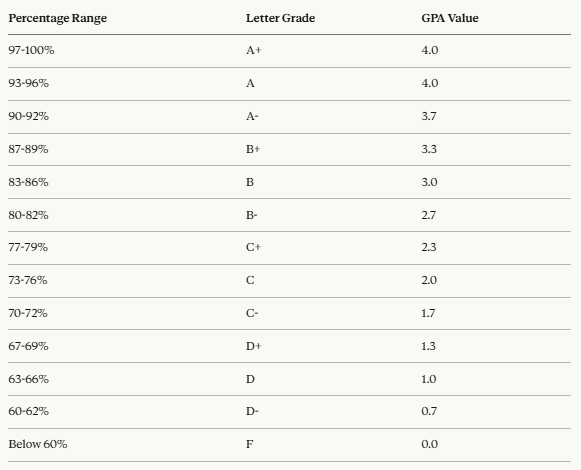
Letter grades by percentage follow standard ranges that most schools use. Having a quick reference guide helps students convert grades without doing calculations.
Here’s a comprehensive standard percentage ranges chart:
How to read conversion tables
Find your percentage in the left column. Look across that row to see the matching letter grade and GPA value. It’s that simple.
Printable reference materials help students keep these conversions handy. Many students tape a chart inside their binder or locker. Having quick access to conversion information reduces stress and speeds up grade checking.
Understanding Different Percentage Ranges
School variations in grading scales mean not every institution uses the exact same ranges. Some schools set higher standards for As, requiring 94% instead of 90%. Others might be more lenient with failing grades, setting the cutoff at 55% instead of 60%.
College vs high school differences can be significant. High schools often use the standard 90-80-70-60 scale. Colleges sometimes employ stricter grading. A college course might require 93% for an A. Graduate programs can be even tougher, with some requiring 95% or higher for top grades.
Plus and minus grade percentages add detail to the basic letter system. Not all schools use plus and minus designations. When they do, the ranges break into three-point segments. For example, 87-89% is B+, 83-86% is B, and 80-82% is B-.
Common Letter Grade Percentages Explained
What is an 80 Letter Grade?
An 80 letter grade represents a score right at the boundary between B and C grades. In most grading systems, 80% falls into the B- category. This score shows good performance with room for improvement.
Breaking down the 80% score helps understand what it represents. If a test has 100 points, scoring 80 means getting 80 questions right and 20 wrong. On a 50-point quiz, 80% means earning 40 points. The percentage stays the same regardless of total points.
What this grade means for your GPA depends on the school’s conversion system. Most schools assign a B- the value of 2.7 on a 4.0 scale. This is respectable but leaves room for improvement toward higher grades.
Understanding 85 Letter Grade
The 85 letter grade sits in the B range. At 85%, students show consistent understanding and good study habits. This percentage demonstrates competence without quite reaching excellence.
The letter grade designation for 85% is a straight B in most schools. Some schools using plus/minus systems might call this a B or B+, depending on where they set the boundaries. Generally, 85% falls right in the middle of the B range.
How it compares to other grades: 85% is better than average (70%) but not yet excellent (90%). Students with 85% averages are doing well and have a clear path to As if they put in extra effort.

What Does 88 Letter Grade Mean?
An 88 letter grade is near the top of the B range. This score shows strong performance and understanding. Students earning 88% are very close to A-level work.
Interpreting an 88% score means recognizing that the student got 88 answers right out of 100 possible. That’s missing only 12 points. This demonstrates thorough preparation and good grasp of course concepts.
The impact on overall academic standing is positive. An 88% average puts students in good position for honor roll at many schools. It shows consistent effort and strong academic skills. For college applications, maintaining grades around 88% demonstrates solid academic preparation.
The 90 Letter Grade Threshold
The 90 letter grade marks an important milestone in academic achievement. Reaching 90% means crossing from B-level work into A territory. This threshold represents a significant accomplishment.
Why 90% is significant: It’s the standard cutoff for earning an A in most schools. Moving from 89% to 90% changes a B+ to an A-. This one percentage point difference can impact GPA, and scholarship opportunities.
Meeting A grade standards requires dedication and effective learning strategies. Students earning 90% or higher typically attend class regularly. They complete all assignments thoroughly, ask questions when confused, and review material. These habits separate good students from excellent ones.
Mastering the A Grade Percentage
What Qualifies as an A Grade?
The a grade percentage range spans from 90% to 100%. This represents the highest level of academic achievement in most grading systems. Earning an A shows exceptional understanding and mastery of course material.
Standard a grade percentage ranges break down into three levels:
- 97-100% = A+ (Outstanding, nearly perfect)
- 93-96% = A (Excellent, strong mastery)
- 90-92% = A- (Very good, solid excellence)
These distinctions help differentiate between exceptional and truly outstanding work. Not all schools use these fine gradations, but many do to recognize top performers.

A+ vs A vs A- distinctions matter for highly competitive academic situations. Some colleges and scholarship programs look closely at grade details. An A+ average demonstrates consistent excellence. A straight A shows strong performance. An A- indicates very good work that occasionally falls short of perfection.
Tips to Reach A Grade Percentage
Reaching a grade percentage levels requires effective study strategies. Top-performing students use specific techniques that maximize learning and retention.
Study strategies for top grades include:
- Start studying early, not the night before tests
- Break material into smaller chunks to learn gradually
- Use active recall by testing yourself on information
- Create study guides that organize key concepts
- Form study groups to learn from peers
- Ask teachers questions when concepts are unclear
- Review notes within 24 hours of class to reinforce learning
Test preparation methods that work:
- Take practice tests under timed conditions
- Identify weak areas and focus extra time there
- Get plenty of sleep before test days
- Eat healthy meals to fuel brain function
- Arrive early to tests to settle nerves
- Read all questions carefully before answering
- Budget time wisely across all test sections
Consistent performance habits separate A students from others. Top students attend every class, complete all homework on time, and participate in discussions. They view learning as important beyond just grades. This mindset drives continuous improvement and academic excellence.
How to Convert Percentages to Letter Grades
Converting percentages to letter grades becomes easy with a simple process. Follow these steps every time you need to make a conversion.
Step 1: Find your percentage score
Calculate what percentage of points you earned. Divide your points by the total possible points. Multiply by 100. For example, 85 points out of 100 equals 85%.
Step 2: Locate the matching grade range
Use a conversion chart to find where your percentage falls. Look for the range that includes your score. An 85% falls in the 80-89% range, which is a B.
Step 3: Understand what your grade means
Consider what the letter grade represents. A B shows good work with room for improvement. Think about whether you’re satisfied with this performance level or want to aim higher.
Step 4: Track your progress over time
Keep records of all your grades throughout the semester. Look for patterns. Are you improving, staying steady, or declining? Use this information to adjust your study habits and set goals for future assignments.
Regular conversion practice makes this process automatic. Soon, you’ll instantly know that 92% is an A- or that 77% is a C+ without needing to look anything up.
Using Letter Grades by Percentage Charts
Reading Standard Grading Charts
Letter grades by percentage charts provide visual references for quick conversions. Learning to interpret these tables efficiently saves time and reduces confusion.
How to interpret percentage tables
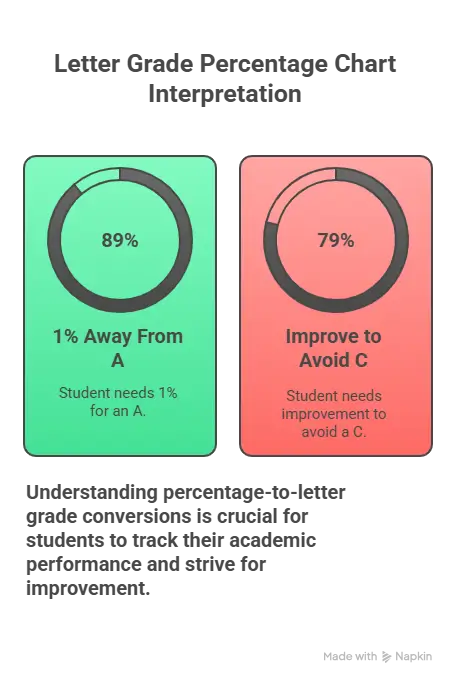
Charts list percentage ranges in the left column and letter grades in the right column. Some charts add a middle column showing GPA values. Read across each row to see all the information for one grade level.
Finding your grade requires scanning the percentage column for your score. Once you locate the correct range, look across to see your letter grade. With practice, this becomes a two-second process.
Understanding grade boundaries is important for students near cutoff points. Someone with 89% should know they are 1% away from an A. This knowledge can motivate extra effort on remaining assignments. Similarly, students at 79% understand they need to improve to avoid dropping to a C.
Creating Your Own Reference Chart
Customizing charts for your school’s system helps ensure accuracy. Since grading scales vary, making a personalized chart based on your specific school’s policies prevents confusion.
Start by finding your school’s official grading policy. This information usually appears in the student handbook or on the school website. Write down the exact percentage ranges for each letter grade.
Including GPA equivalents on your chart adds valuable information. List the letter grade, percentage range, and GPA value all in one table. This comprehensive reference answers multiple questions at once.
Digital vs printed charts each have advantages. Digital charts stored on phones provide instant access anywhere. Printed charts can be posted in study areas for quick reference while doing homework. Many students keep both versions for maximum convenience.
Real Examples of Grade Conversions
Understanding letter grading to percentage conversions becomes clearer with real examples. Let’s work through several common scenarios.
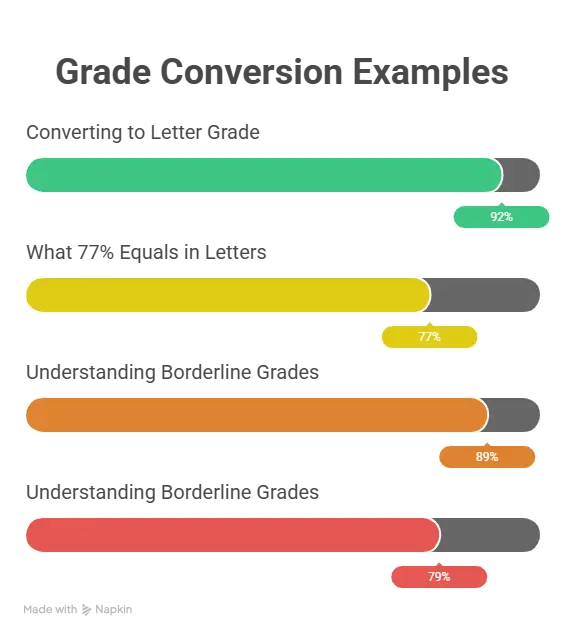
Converting a 92% to a letter grade:
92% falls in the 90-92% range. In most schools, this equals an A-. Some schools without plus/minus grades would call it an A. Either way, it represents excellent work.
What does 77% equal in letters?
77% sits in the 70-79% range, which is a C. More specifically, using plus/minus grades, 77% would be a C+ (typically 77-79%). This shows average to slightly above-average performance.
Understanding borderline grades (89%, 79%, etc.):
Borderline grades require special attention. An 89% is one point away from an A, making it a B+ (or B without plus/minus). This can be frustrating for students who came so close to the next level.
Similarly, 79% is on the edge between C+ and C, or between C and D depending on the grading scale. Students with borderline grades should consider talking with teachers about extra credit opportunities or ways to improve before the semester ends.
These examples show why understanding exact percentage ranges matters. A single percentage point can make the difference between grade levels.
Tips for Students Using Letter Grade Scales
Students can maximize their success by following practical strategies for working with grade scales.
Check your school’s specific grading policy at the beginning of each semester. Don’t assume all teachers or schools use the same scale. Get the official information from syllabi or school handbooks. Knowing the exact requirements prevents surprises later.
Track grades throughout the semester using a notebook, spreadsheet, or grade tracking app. Don’t wait until report cards to see where you stand. Calculate your current grade after each major assignment. This ongoing awareness helps identify problems early when there’s still time to improve.
Use calculators to predict final grades by entering “what-if” scenarios. Before a final exam, calculate what score you need to reach your target grade. This information helps prioritize study time and set realistic goals. A percentage to letter grade calculator makes these predictions quick and accurate.
Set realistic grade improvement goals based on current performance. Someone with a 75% average shouldn’t expect to jump to a 95% overnight. Instead, aim for incremental improvements. Set a goal to reach 80%, then 85%, working toward excellence gradually. Achievable goals maintain motivation and lead to lasting improvement.
Tips for Teachers: Explaining Grade Conversions
Teachers play a crucial role in helping students understand grading systems. Clear communication prevents confusion and helps students succeed.
Clear communication with students starts on day one. Explain the grading scale during the first class. Show examples of how different scores convert to letter grades. Give students time to ask questions. Many students have never learned how grades work, so patient explanation is essential.
Providing conversion charts helps students reference grading information anytime. Post a chart in the classroom where everyone can see it. Include it in syllabi and course materials. Consider giving students wallet-sized cards with the conversion chart for quick reference during tests.
Handling grade questions effectively requires patience and transparency. When students ask about their grades, take time to show the calculations. Walk through how each assignment contributed to the final percentage. Explain what they need to do to improve. This personalized attention helps students take ownership of their academic performance.
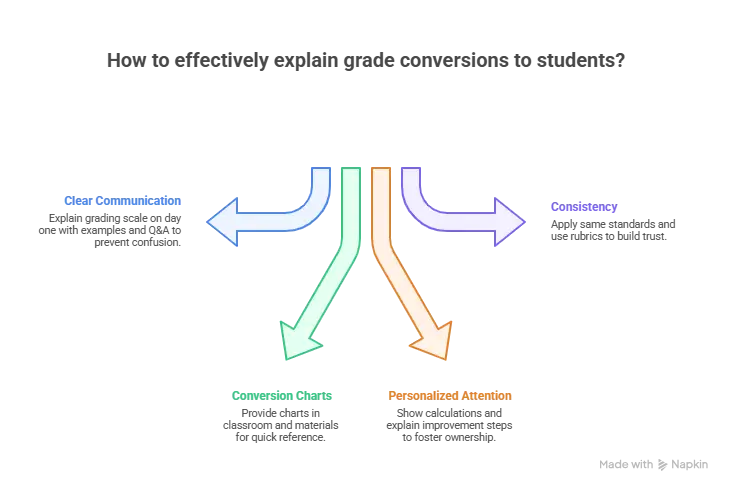
Maintaining grading consistency ensures fairness for all students. Apply the same standards to everyone’s work. Use rubrics that clearly define expectations. Double-check calculations before posting grades. Consistency builds trust and helps students understand exactly what’s required for success.
Common Mistakes When Converting Grades
Even with tools and charts, students and teachers sometimes make conversion errors. Awareness of common mistakes helps avoid them.
Rounding errors and how to avoid them:
Some people round too early in calculations, which can change final results. For example, converting 87.4% to 87% and then to a letter grade might drop someone from a B+ to a B. The correct approach is to use the exact percentage (87.4%) for conversion. Most schools have policies about when and how to round—follow these precisely.
Misreading percentage ranges:
Students sometimes confuse which range their score falls into. An 89% is in the 80-89% range (B), not the 90-100% range (A). Reading charts carefully prevents this mistake. When in doubt, verify with the teacher.
Forgetting about weighted grades:
Many courses weight different categories differently. Tests might count 50% while homework is only 20%. Students sometimes average all scores equally, giving incorrect results. Always apply the proper weights when calculating overall grades. Use a letter grade average calculator designed for weighted grades to avoid this error.
Not checking school-specific policies:
The biggest mistake is assuming all schools use the same grading scale. Each institution sets its own policies. Always verify the specific scale your school uses. What counts as an A at one school might be an A- at another. Check official documentation rather than making assumptions.
Conclusion
Understanding how to convert percentages to letter grades empowers students to take control of their academic success. This guide covered everything from basic conversion charts to advanced calculator tools. The key concepts include knowing standard percentage ranges, using helpful calculators, and understanding what each grade level represents.
Students now have the knowledge to quickly convert any percentage to its letter grade equivalent. Whether dealing with an 80 letter grade, an 85 letter grade, an 88 letter grade, or a 90 letter grade, the conversion process is straightforward. Tools like a letter grade calculator or letter grade average calculator make tracking grades even easier.
Encouragement to use available tools: Don’t struggle with grade calculations alone. Take advantage of online calculators and conversion charts. These resources save time and provide accuracy. Regular grade tracking using these tools helps identify areas for improvement before it’s too late.
Final tips for grade success: Stay organized with your grades, communicate with teachers when confused, and set realistic improvement goals. Remember that grades measure current performance and learning progress. With consistent effort and the right tools, every student can improve their academic standing and reach their goals.
FAQs
How do you convert percentages to letter grades?
To convert percentages to letter grades, first find your percentage score. Then match it to the standard grading ranges: 90-100% is an A, 80-89% is a B, 70-79% is a C, 60-69% is a D, and below 60% is an F. Many schools add plus and minus grades for more detail. For example, 87-89% is typically a B+. Use your school’s specific grading chart for the most accurate conversion. A letter grade calculator can do this instantly if you prefer a quick digital solution.
What letter grade is 85%?
An 85 letter grade equals a B in most grading systems. Some schools using plus/minus grades might call it a B or B+ depending on where they set the exact boundaries. Typically, 83-86% is considered a straight B, while 87-89% is a B+. An 85% shows good performance and solid understanding of course material. It’s above average work that demonstrates consistent effort and competence.
Is 88% an A or B grade?
An 88 letter grade is a B grade, specifically a B+ in schools that use plus/minus grading. It falls just short of the 90% threshold needed for an A. While 88% represents strong performance and near-excellent work, it hasn’t quite reached A-level standards. Students with 88% are very close to an A and might reach it by scoring well on remaining assignments. It’s definitely above-average performance worth being proud of.
What percentage is needed for an A grade?
An a grade percentage typically requires 90% or higher. Most schools set the A range from 90-100%. More specifically, many schools break it down as: 90-92% for an A-, 93-96% for a straight A, and 97-100% for an A+. However, some schools set stricter standards, requiring 93% or even 94% for an A. Always check your specific school’s grading policy. Reaching this percentage consistently shows excellent understanding and mastery of course material.
Can I use a calculator to convert my grades?
Yes, using a letter grades calculator is an excellent way to convert grades quickly and accurately. Many free online calculators are available that instantly convert percentages to letter grades. These tools are especially helpful when dealing with weighted grades where different assignments count for different amounts. Simply enter your percentage score, and the calculator shows your letter grade. Some calculators also include GPA conversions and “what-if” features to predict future grades. Using these tools saves time and eliminates calculation errors.